

Penalty shootouts are changing, and this year's World Cup is just the start
After four penalty shootouts at this year's World Cup, what does the data say about the future of penalty shootouts?
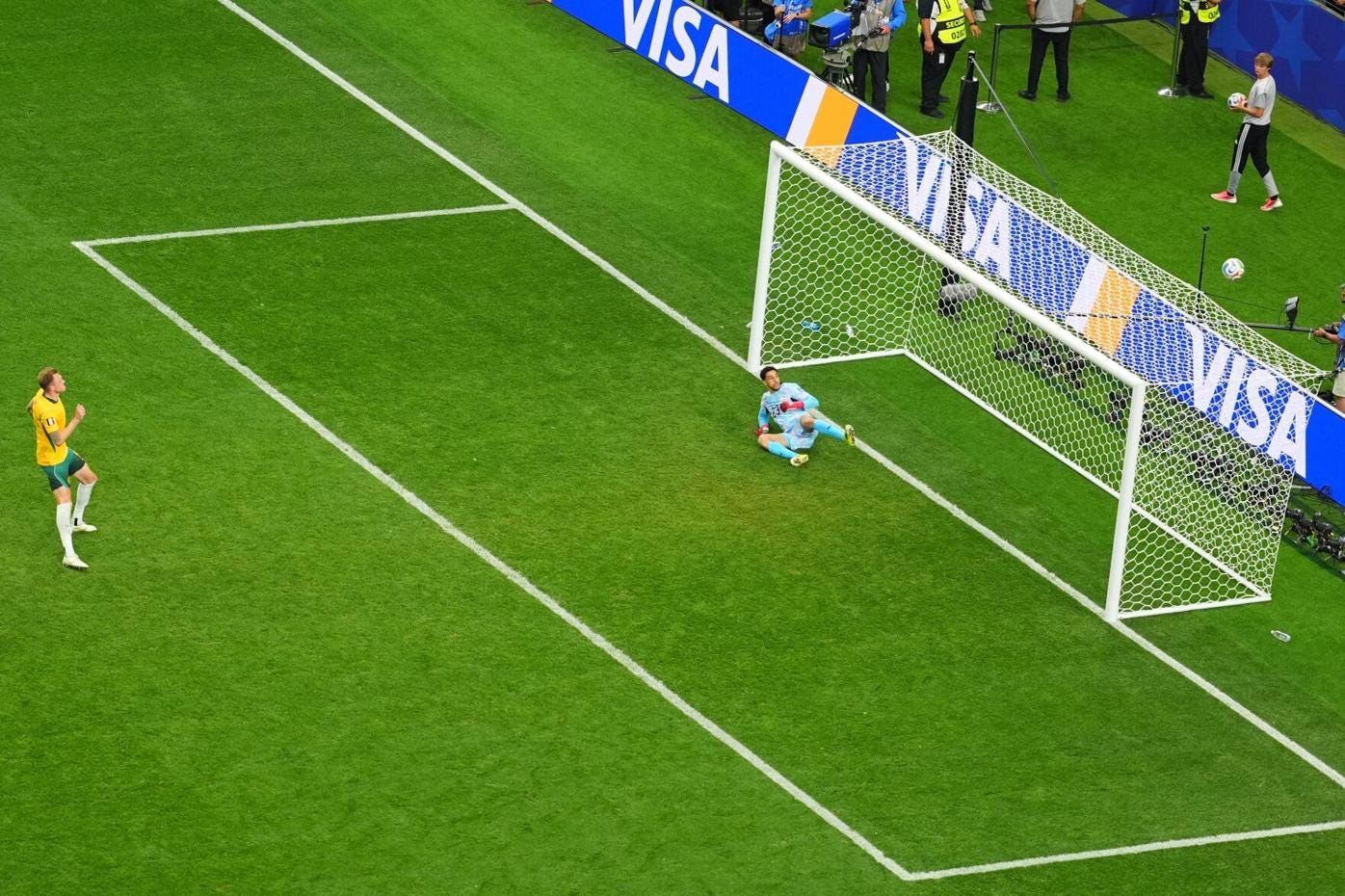
Penalty shootouts have always been somewhat of a gamble to many football clubs and national teams. But it is a gamble that many are willing to take, especially underdogs in knockout tournaments who see that gamble as their best way to win the match.
After four penalty shootouts so far in the 2026 World Cup, that still seem to somewhat be the case. Paraguay and Australia pushed Germany and Egypt respectively to a shootout as underdogs, but only Paraguay came out victorious in the Round of 32. Meanwhile, equal-strength pairings Netherlands and Morocco, Switzerland and Colombia matched each other and had to settle the fight from the 18-yard spot, where Morocco and Switzerland came out victorious.
While, as of writing, the number of penalty shootouts have been on par with past tournaments despite the extended number of matches, there seems to be a sense that teams actively avoided going into shootouts. In most cases, teams preferred to settle the match within 90+ minutes and avoided going into extra time entirely. Besides from the four matches that went to penalty shootouts, only four other matches went into extra time as of the quarter-finals.
The data seem to support that as well. According to Opta’s data, the number of goals scored after the 85th minute was 16 goals as of after the quarter-finals, the most among all periods during the match. The number of winning goals also followed that trend with 12 goals, whereas other periods only saw one or two winning goals scored. Obviously the caveat with this visualisation is that these goals are not categorised by game state, but this still supports my hypothesis well enough.
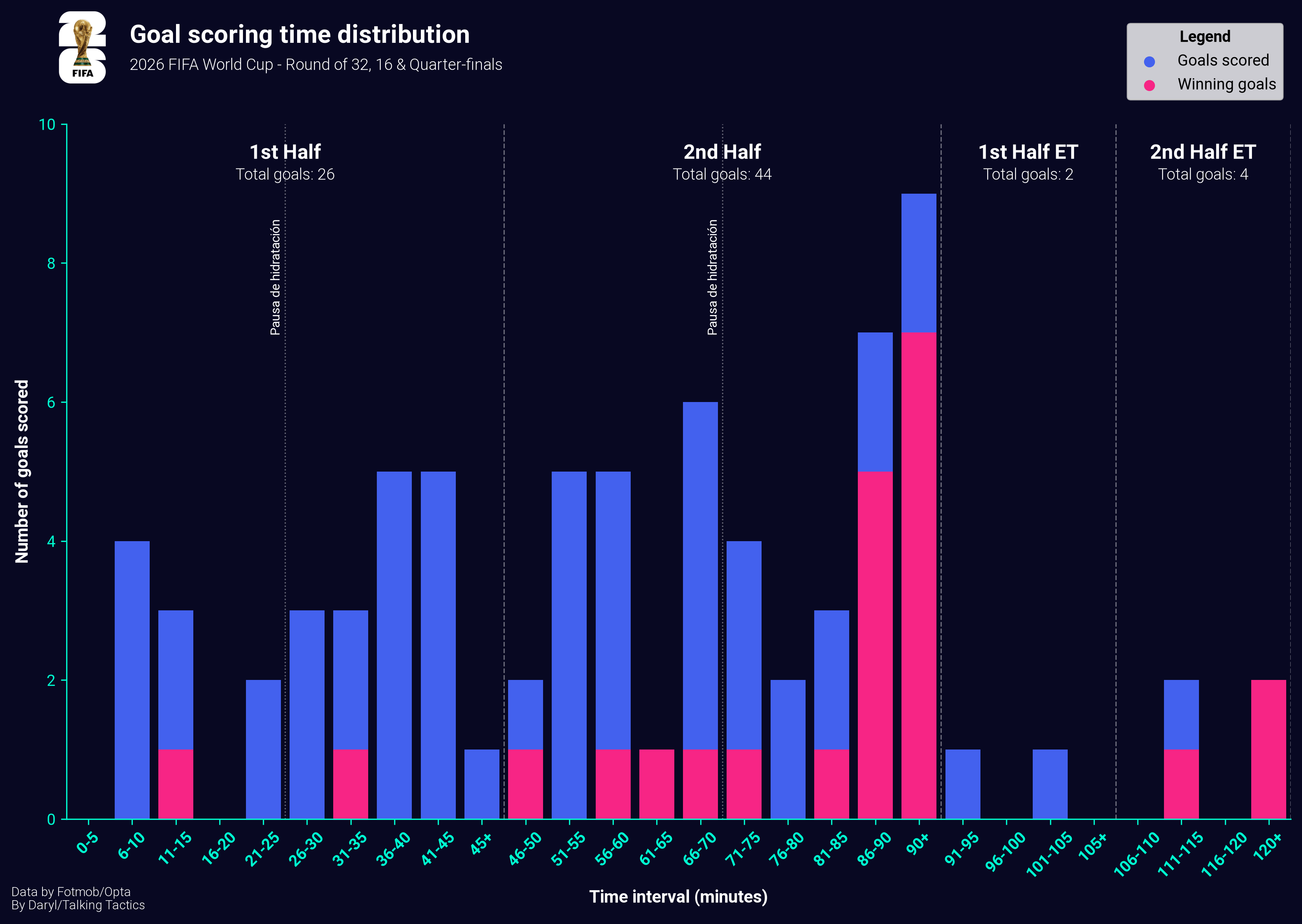
The introduction of water breaks/hydration breaks (or pausa de hidratación in Spanish, for funsies) due to the extreme heat has introduced another variable to the equation. Coaches used these breaks to quickly brief the players on tactical changes, while the players themselves got a quick rest to re-energise. As such, these breaks were used to sway the momentum of the match towards them, which allowed for more goals to be scored, especially inside the first half.
Besides from having to play an extra 30 minutes, teams and players have been hesitant to drag the match into the penalty shootouts was because of the psychological aspect of it. With the use of data and video analysis being a staple among every coaching staff at this World Cup, it has been a lot harder to score a penalty compared to past tournaments. When everything is at stake going into a penalty shootout, teams will be a lot more incentivised to do their homework properly by preparing their players and keepers on where to shoot and where to dive respectively.
This has encouraged teams to take more risks before the penalty shootout. Firstly, through their order and player selections. A lot have been said about centre-backs stepping up to take a penalty this World Cup and the result of that decision has been slightly bad. On the contrary, however, midfielders have shown to be very reliable takers, with attacking midfielders, wide midfielders, and wingers leading the way for penalty conversion rate during penalty shootouts (80%), followed by defensive and central midfielders (70%). Once again, according to Opta’s data from Fotmob, 75% of defensive or central midfielders and 66.7% of attacking midfielders successfully converted their team’s opening penalty, while 100% of wide midfielders or wingers converted the third penalty.
More surprisingly, though, is that only one in four striker have converted their team’s fourth penalty while strikers have not been trusted very often in other penalty taking orders. Strikers are usually seen as very composed and confident in front of goal, yet coaches seemed to not believe that after four penalty shootouts. This could be the result of teams doing their homework properly on where strikers would usually shot towards, thus made coaches less confident that the striker would successfully convert the penalty.
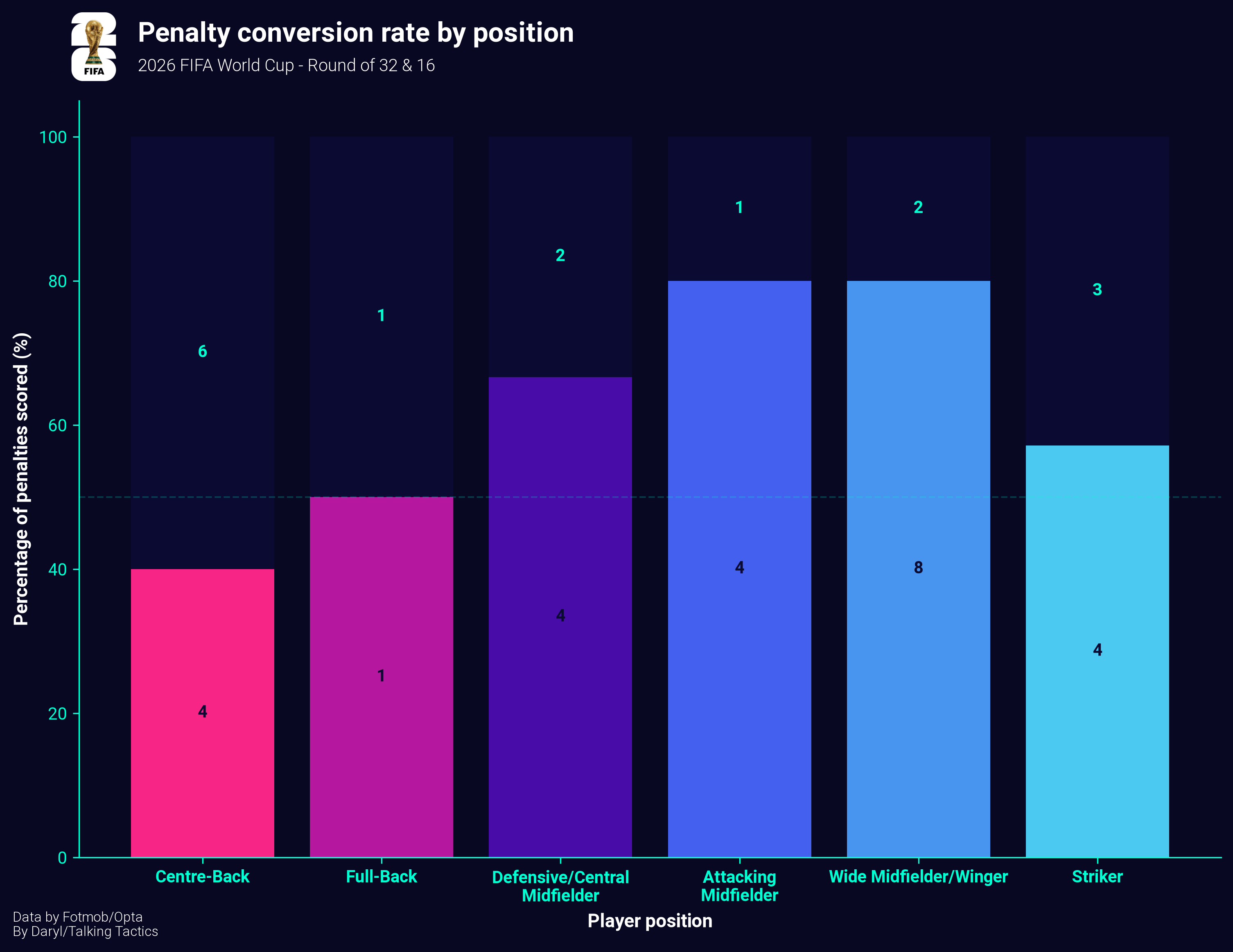
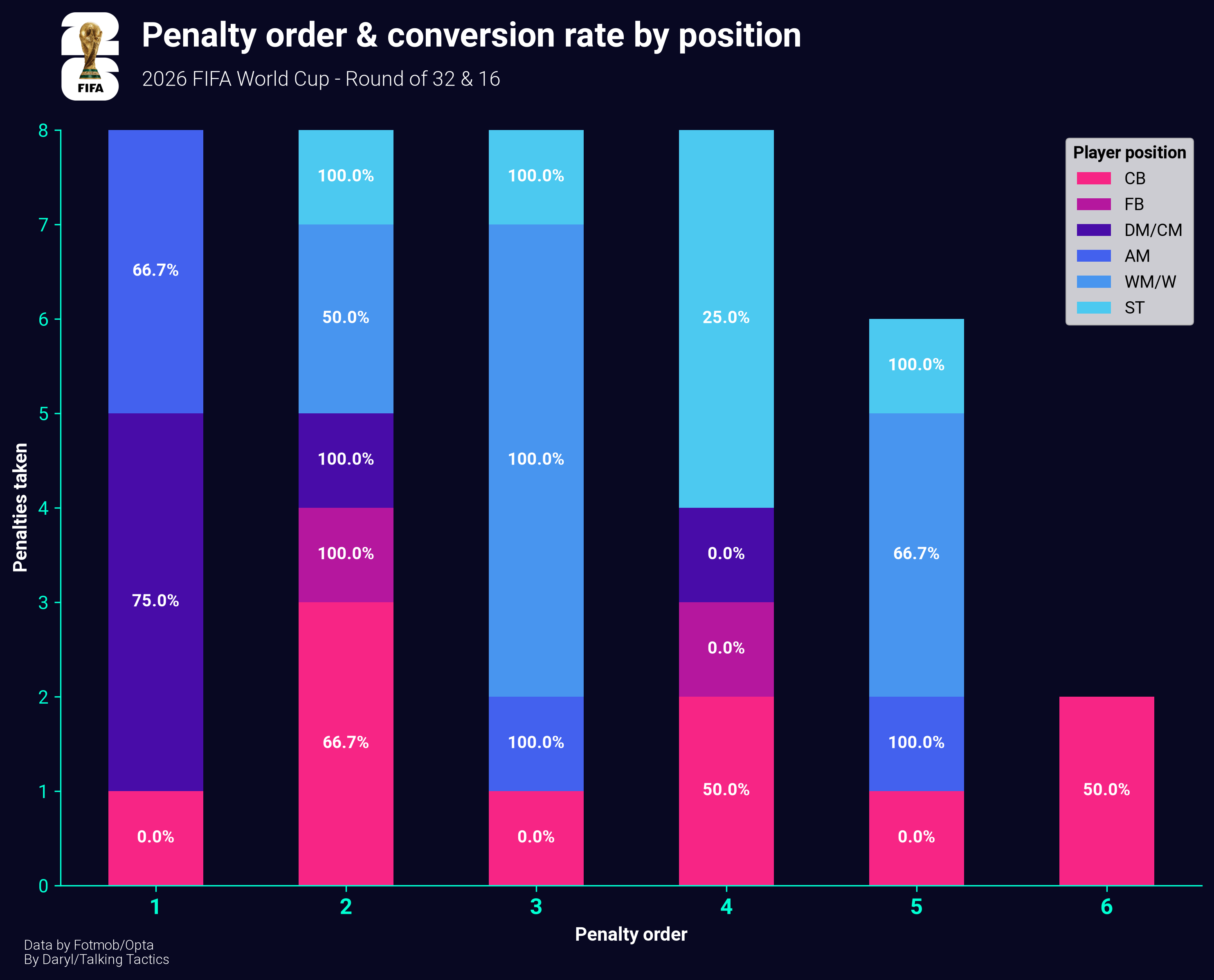
The penalty conversion rate for all midfielders so far has only reinforced the belief that more skillful and technical players are better at taking penalties. This is despite the fact that many teams have access to data and clips of midfielders taking penalties to do their homework on.
But, this also begs the question, why aren’t full-backs being given the opportunity to take a penalty? During an era where the demands for full-backs are a lot higher and they are involved in most phases of play, the technical ability of full-backs have also risen a lot higher. That is not mentioning players who take on a hybrid role of both a full-back and a winger like Morocco’s Achraf Hakimi, Australia’s Jordan Bos, or England’s Djed Spence, all of whom have to dribble with the ball and take on opposition players on an often basis like a traditional winger.
Once again, going back to the point that teams now have deeper access to data and video of midfielders and forwards taking penalties, this might be the turning point where full-backs will be assigned as one of the penalty takers more often moving forward. This will only give coaches more penalty taking options in the squad, thus allowing for more rotations and preventing teams from doing homework properly in the future.
The potential emergence of full-backs taking penalties does not mean that more defenders will be taking penalties, as shown by the centre-backs’ conversion rate after four penalty shootouts, which is one of the main points of this article. Some centre-backs were forced into taking a penalty due to other teammates who felt nervous and were hesitant to step up, like Germany’s Jonathan Tah’s case against Paraguay. Some felt very planned by the coaching staff and might or might not have trained for the shootout scenario before the match, like Australia’s Harry Souttar and Lucas Herrington.
It is hard to know the actual truth without asking the coaches and players themselves, all we can do here is speculate based on what was said after the match and how confident the players were before stepping up to the 18-yard spot. But in both cases, it is still important to give the centre-backs the credits that they deserve for stepping up to take a penalty when others chose not to.
With a lower level of technical ability compared to teammates in other positions, it makes sense as to why centre-backs have either missed their penalty or have their penalty saved. Instead of choosing precision, centre-backs like Souttar, Herrington, Tah, Switzerland’s Manuel Akanji, and Colombia’s Davinson Sánchez opted for power and aimed for higher corners. Their instinct to clear the ball from danger did not help because they put too much power into their shot, thus allowed the ball to hit the crossbar or clear the goal completely.
Interestingly enough, the two Paraguayan centre-backs who converted their penalty, José Canale and Gustavo Gómez, along with another Paraguayan centre-back in Fabián Balbuena, all chose to place their penalty low instead. That gave all three a higher chance to score against Germany’s Manuel Neuer, and both Canale and Gómez’s penalties were crucial in Paraguay’s win over the 2014 world champion in the Round of 32. The other centre-back who also placed his penalty low, and scored, was Egypt’s Rami Rabia against Australia, who received a briefing of Mat Ryan’s early diving tendency right before the penalty shootout and might have been influenced to make such decision.

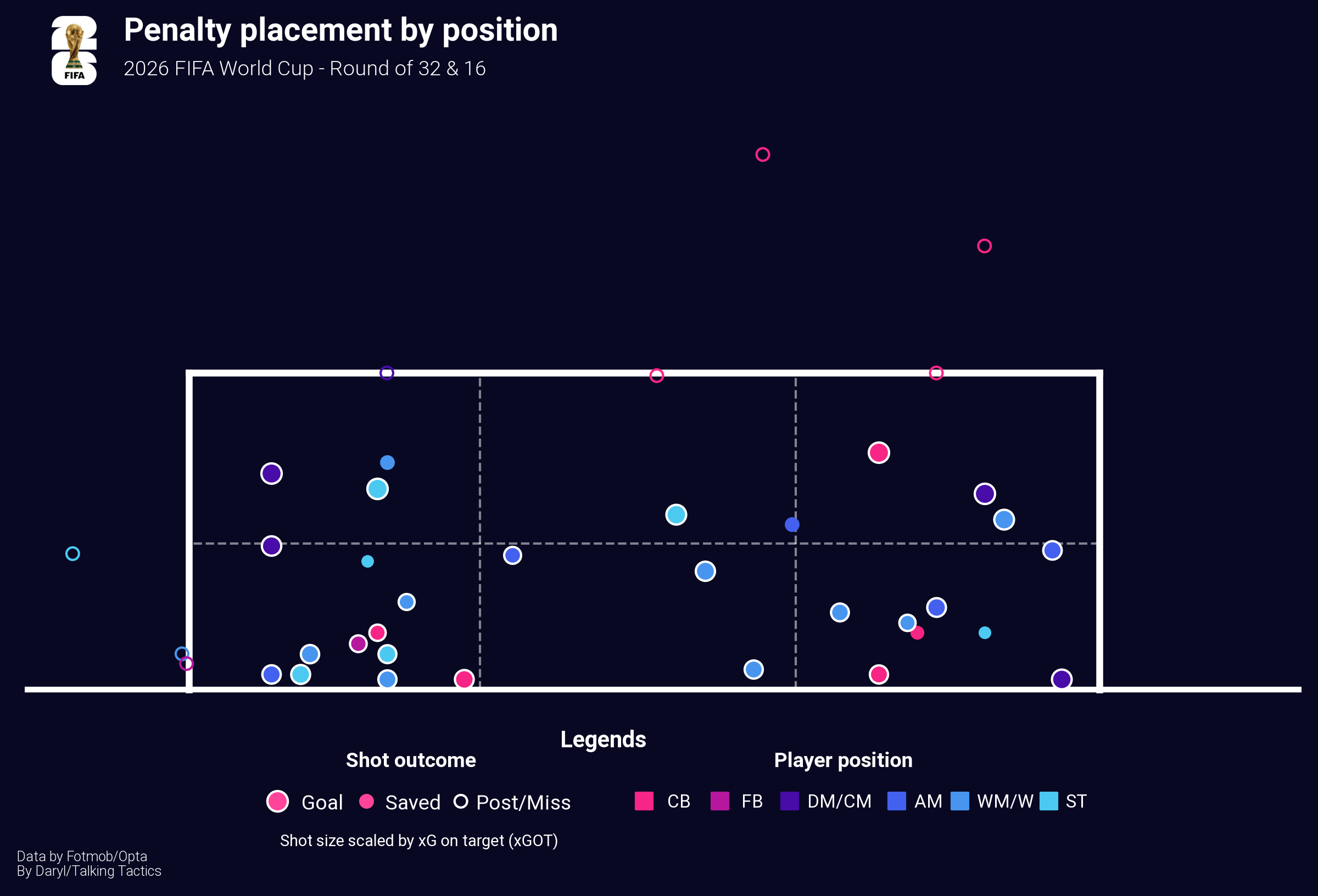
It is also interesting to see how cautious a lot of players were when stepping up to take a penalty. Many players still chose to avoid shooting straight down the middle of the goal or into higher corners despite the fact that those areas tend to have the highest conversion rate. Instead, a lot of penalties were aimed low into bottom corners, especially on the left-hand side of the goal.
That was the favourite aiming area for most attacking midfielders, wide midfielders, wingers, and strikers. But a few still decided to go rogue and aimed for the middle instead, and all four players (Egypt’s Mohamed Salah, Australia’s Awer Mabil, Switzerland’s Cedric Itten, and Colombia’s Juan Quintero ) managed to score. Defensive and central midfielders have gone close to those high corners, but their penalty were still aimed at tough areas to save in the end.
Many players chose to be cautious because of how stressful penalties could be, which have been well-documented at this point. Even with the psychological work that has been done to make players feel more confident at taking penalties, a penalty shootout still bring a lot of dread and anxiousness to a player’s mind. The long walk up to the 18-yard spot, the pressure of delivering for your club or country in an important match, then having to face the keeper who is potentially doing tricks to your mind, and potential delays that only make the moment longer. All of those factors will affect a player’s confidence no matter what, especially for players who have not taken that many penalties.
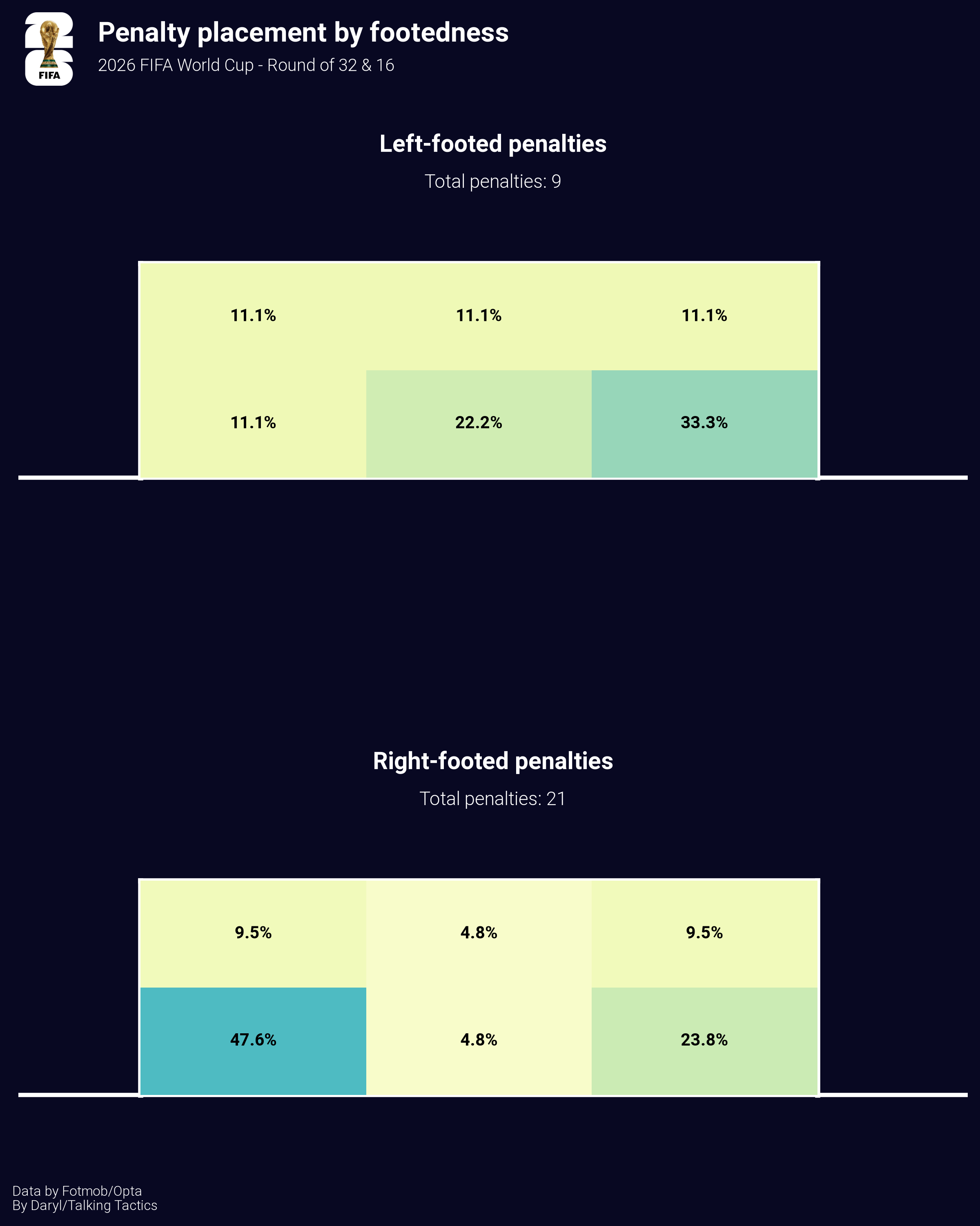
As such, it is understandable that many players chose to do something that they already know or have trained many times, which was shooting towards the opposite direction to their preferred foot. It did not matter whether a player was left-footed or right-footed, there was a high chance that the penalty would be aimed towards the opposite direction, which could easily be predicted from their run up.
Right-footed takers have added a tiny bit more variety by aiming at the bottom right corner instead, but instead very avoidant of the middle corner compared to left-footed takers. It is so interesting to me that out of the 21 penalties taken by right-footed takers during penalty shootouts at the World Cup so far, almost half were aimed at the bottom left corner. Yet, the success rate for penalties aimed towards this area was still very high, which could be because players have found a good balance between placement and power.
So, let us go back to the question that started this entire article. What do all of those data say about the future of penalty shootouts?
Firstly, teams are definitely more aware of the psychological toll that a penalty shootout brings. Even though it is exciting to watch as a fan or a neutral, most players and teams definitely do not enjoy shootouts and will try to settle the match in 90 minutes instead. While there will be less or equal to the number from past tournaments (4 or 5 throughout the entire tournament), it will mostly be utilised by underdog teams who prioritise a defence-first playing style to give themselves a chance to go further into a tournament.
Secondly, coaches might want to utilise full-backs as one of their penalty takers since they now possess similar technical ability to midfielders or wingers. Having full-backs on the penalty taker list give coaches another option to rotate, thus provide more noise to the penalty data and video, making it harder for the opposition to do homework on them.
Lastly, because of the psychological toll of penalty shootouts, many players will continue to choose the safe and tested option, which is to aim the ball at the opposite bottom corner to their preferred foot. It will continue to work…until it does not, especially when keepers can dive faster or earlier without getting baited by the stuttering penalty. At that point, it might be time for players to consider aiming penalties into higher corners or straight down the middle instead.
A lot more can and will be done to help players with taking penalties, especially on the training ground and on the psychological side. With technology and sport science only getting better from here, I can definitely see the implementation of simulated penalty shootouts through VR headsets or indoor room layouts built specifically for simulating match scenarios. This will allow the players to feel more comfortable with penalty shootouts, from the long walk to after taking the penalty, by visualising different situations again and again, similar to how motorsport drivers train on simulators before they actually race at a specific racetrack.
Obviously, the argument against this is that simulated scenarios are different to real world scenarios, and you can only train so much on simulators. While that is true, the same can also be said for other match scenarios, where players can only train and prepare so much for a phase of play. But having something repetitive on a player’s mind will help them feel more comfortable in actual situations as they can draw from experience on the training ground and on simulators. Then, it is up to the player to make quick decisions on the fly and improvise when the actual scenario happens.
Until that day happens, however, we will have to get use to centre-backs taking penalties and a slightly higher rate of missed penalties thanks to the emergence of data, video, and analysts doing their due diligence.