

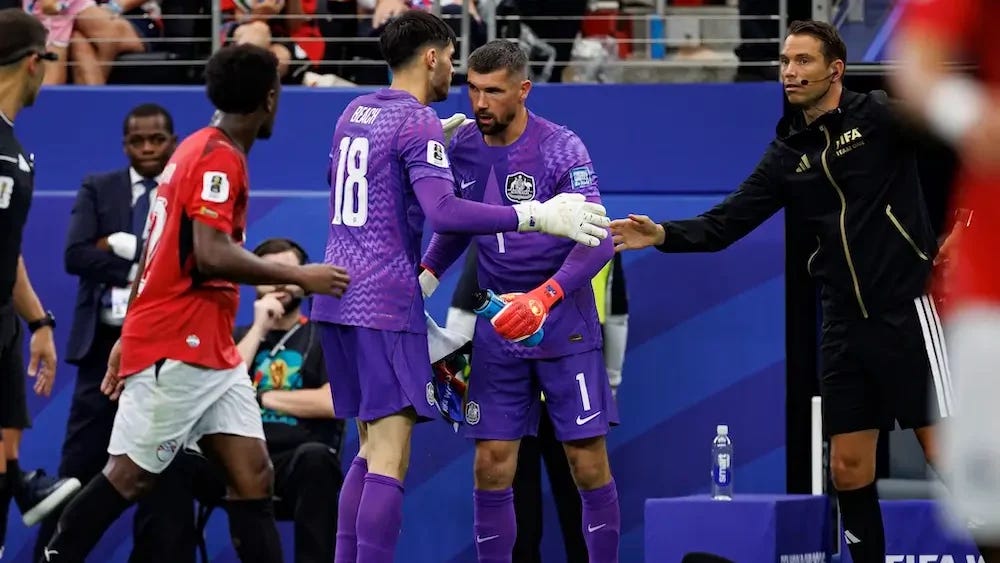
You have read the title and the subtitle. You are thinking, I am an idiot and I am in the very minority. If that is your conclusion of me and do not want to hear my explanation, then feel free to leave. But for those who want to read what I have to say, thank you for choosing to stay. This is not a joke article, by the way.
I was never a huge fan of Tony Popović and have not been very impressed with what he has done with the Socceroos. Yes, he took them to the World Cup with a very pragmatic style of football. The ‘whatever gets the job done’ style of football is what I like to call. That style gave them the 2-0 win over Türkiye as well, which was arguably one of the best defensive performances during Popović’s tenure with the Socceroos. That might have swayed some fans over to support him, but I was not one of them.
Fast forward to Australia’s round of 32 clash with Egypt, there was no doubt that they deserved to lose just by their performance in the 120 minutes of playing time. There were questionable decisions made during that match and the group stage matches, like starting Nestory Irankunda as a lone striker in all but the match against Türkiye, or starting Matthew Leckie and Nishan Velupillay against the US. But I have seen many blamed the lost to Egypt on the substitute that saw goalkeeper Mat Ryan came on for Patrick Beach right before the penalty shootout, who had a good performance up to that sub, and I do not really agree. Here’s why I am willing to die on this hill.
Hindsight and recency bias
It is easy to reach conclusions after the match has finished because everyone know the result already. This is even more exaggerated after a penalty shootout where emotions have taken over, which means losing hurts a lot more and people tend to find and hang onto the most recent reason to cope with the loss. Those are hindsight and recency bias, and it is dangerous because you can be pointing fingers at the wrong reason for that lost. Australia’s lost to Egypt is a good example of that.
Many are pointing to the Ryan-Beach sub as the main reason for Australia’s lost. In reality, Australia have not done enough to win the match in any sense. Throughout the entire 120 minutes, according to Fotmob/Opta (and Sofascore) data, Australia made 16 shots, accumulated a total of just 0.84 xG, and only 1 of their shot was on target. They were kept alive in the match by an own goal, if not then they would have already been out. In contrast, Egypt made 14 shots, accumulated a total of 1.32 xG, and 3 of their shots were on target. Egypt were also not good either, but in a match where both teams were bad, Australia were worse and did not deserve to win. That begs the question, if Australia did not get the own goal and lost during regular time, who would be blamed for that lost instead of everyone blaming it on the Ryan-Beach sub?
To remove hindsight and recency bias from the final judgement, it is important to consider the context around what is being judged. Saying that the Ryan-Beach sub was the main reason why Australia bottled their chance against Egypt means that the entire match was not taken into account. Australia did not deserve to win the match anyway, and I do not think the outcome would have changed if Beach had stayed on.
What does the data say?
Data is another tool that can be used to make judgements and potentially remove hindsight from the judgement. Although, there is a catch with using data because you still need the context around and behind the data to understand the entire picture, instead of just looking at the number alone.
I do not doubt that Beach is a very good shot-stopper and the data across this World Cup shows that. According to Fotmob/Opta, Beach’s successful save percentage was 82.4%, only conceded 3 goals after 4 matches, and prevented 0.28 goals per 90s, all metrics where he ranked amongst the top 10% of World Cup keepers at the time of writing. I got the chance to see how good Beach was during the last couple of A-Leagues seasons where he was brilliant in goal for Melbourne City, so I was not too surprised of his shot-stopping ability at this World Cup.
But being a good shot-stopper does not directly translate to being a good penalty-stopper. Goalkeepers tend to have more time to react to a normal shot from open play, meaning they can dive earlier to reach the ball and push the ball away into less dangerous zones. They can also predict the ball’s trajectory easier, depending on how each team defend, allowing them to move towards one side of the goal quicker and earlier. Their physicality can also be an advantage, especially with Beach’s height.
Penalty is a completely different beast. The distance to goal is much shorter, meaning there is less time to react to where the ball is going. There is also no defender standing in between the keeper and the striker, and while that means there can be no deflection to make the shot harder to save, it also means the amount of time for a keeper to make decision is a lot shorter than a normal shot. And I mean very short, in the millisecond scale. This is an entire different topic that you can find some readings to read from football researchers or even coaches, but good penalty takers can place their shot well into tough angles and put power into it, which means the keeper cannot react to it quick enough to save it.
Those are just some of the technical sides of shot stopping and penalties, there is also the psychological aspect of it. Some keepers are more confident than others (see Argentina’s Emiliano Martínez as an example), so they feel more relaxed before saving a penalty. That is just normal human nature, even athletes are not immune to that. Keepers tend to build confidence based on their own experience, because a penalty is pretty much an unknown, so they can only rely on past experiences to help them make a split-second decision.
So, how does all that apply to Australia’s penalty shootout lost against Egypt, and the Ryan-Beach substitution?
I am too lazy to gather all penalty data, so I will borrow a visualisation that I spotted on BlueSky just before the penalty shootout.
Even though the sample size for Beach is quite small, the visualisation above from Max Oosterwegel showed that Beach is worse at saving penalties and had less chance to save one during a penalty shootout. His records from last season supported that too (even though I am unsure if Max’s dataset included these two shootouts). Against Auckland FC in last season’s A-League quarter-final and against Buriram United also in last season’s AFC Champions League Elite Round of 16, Beach faced a total of 11 penalties across two shootouts and saved…none. In contrast, both opposition keepers, Auckland’s Michael Woud and Buriram’s Neil Etheridge, saved one and two each to give their side the win.


The data did not support Beach but the actual match did not support Beach’s case either. Against Auckland, Beach either went the wrong way on five penalties or dove too low to save two penalties that were going to the top corner. His height could have played a bit of a disadvantage because it slowed him down and did not allow him to react quick enough. Against Buriram, he also went the wrong way on two occasions. On the one time where he went the right way, he was too slow to reach a penalty that was placed very well into the bottom right corner.
Judging on those observations alone and without taking into account Beach’s performance during the Socceroos’ shootout training before the Egypt match, it would be hard for any coach to be confident in choosing Beach for a penalty shootout that had a lot of stakes and pressure like the one against Egypt.
Meanwhile, Ryan was available on the bench, had more experience, the data supported him as the best penalty stopper among the Socceroos’ keeper unit, and had saved penalties before. Not that Ryan’s penalty stopping ability is much better because he only saved 1 out of 4 penalties faced last La Liga season for Levante, and 1 out of 3 penalties faced the season before for Lens in Ligue 1. But the argument is that he has at least successfully saved penalties in a higher pressure situation. Popović and his coaching staff probably knew that during their preparation for the shootout, which made total sense for them to plan the Ryan for Beach substitution way before the match started.
The human element of football
Another argument that supported the substitution was that Ryan was way more experienced and could have relied on his experience to make a better decision than Beach could have. It is important to remember that last season was Beach’s second full professional season where he got to play with Melbourne City after spending a few years on the bench and with the B team of Central Coast Mariners. While it is hard to doubt that Beach has the potential to be the Socceroos’ number 1 in the future, he still needs a lot more confidence and experience to make the right decision in a high pressure moment like a World Cup penalty shootout.
Many have also argued that Egypt have prepared for the substitution by studying Ryan’s penalty saving tendencies. This was absolutely true, confirmed by this image (that is not AI-generated, by the way!) posted on LinkedIn by one of Egypt’s performance analysts. The players were shown all of Ryan’s penalties faced last season, including one against Real Madrid.
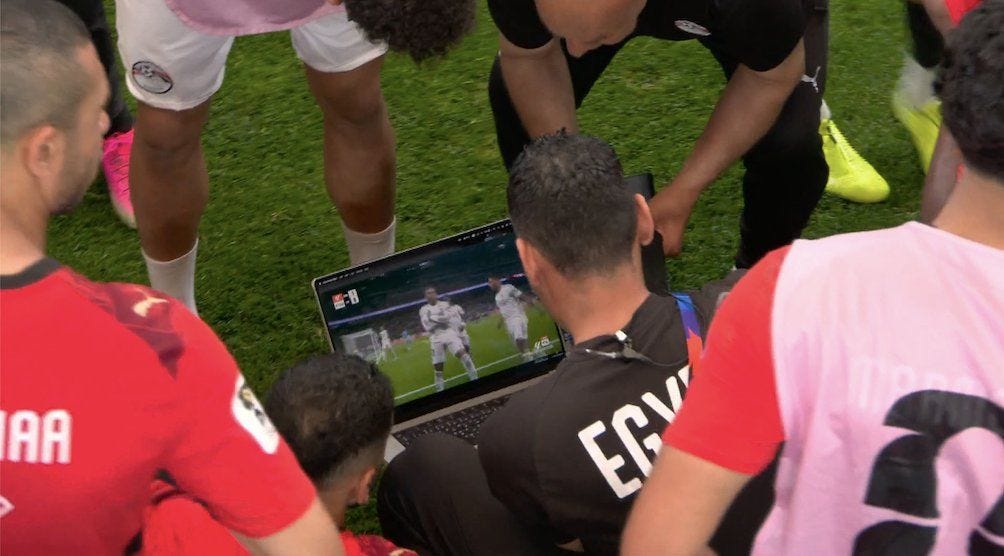
But considering Egypt already had plans to study Ryan’s penalty stopping tendencies, they would have prepared for the scenario that Beach was Australia’s keeper as well. All 12 penalties that Beach faced during a shootout from last season are available to find on YouTube for literally anyone to find, and speaking from experience as an opposition analyst myself, the Egypt analysis team would have done that as well. The players would have known how to take a penalty against either Beach or Ryan either way, thus made the lost more inevitable.
Popović and his coaching staff could either have known or have not known this, depending on how thorough their preparation was. Thus, they could only prepare for what they knew at the time, which was that Ryan was the more prepared keeper to face a penalty shootout. Many could say that it was a substitution that felt out of the blue, but it was totally not because it was definitely planned out by the Socceroos’ coaching staff beforehand. They knew they wanted to drag the match into the penalty shootout, where they would have more chance to win, and prepared for such scenario by leaving out a substitution to bring Ryan on for Beach.
It is easy to look at that decision now and say that it is wrong, because, as mentioned earlier, hindsight is a funny thing. We do not know what would have happened if Beach was in goal during the penalty shootout, and we never will. Maybe if someone invent a universe travelling machine then we might know, but with the technology that we have now, that is not a possibility. Australia’s coaching staff prepared for the penalty shootout as best as they could, and they made the decisions that they thought were right, and most of them simply did not work out.
As much as I am a data-driven person and will say “let’s use data and build prediction models to make sure these decisions are right”, there is only so much that data can predict, especially with predicting the unknown, and the rest are left for human thoughts and interpretations to fill in. I have worked in football long enough to understand that the players and coaching staff are still normal humans at the end of the day with their own worries and nervousness. They handle things better than normal humans, but it does not mean that those worries and nervousness completely disappear during the match or during a high pressure situation. The best that they can do to overcome that is to prepare as best as they can and to the best of their knowledge.
In unknown situations and in the heat of the moment, sometimes, data will triumph. Other times, human intuition will triumph. That was the moment when Mat Ryan came on for Patrick Beach. At that moment, no one knew if the substitution would have worked out or not. The Socceroos coaching staff could only trust the plan that they had crafted before the match started and what they trained on. It could have gone either way, and unfortunately, it went the worst way.
Wrap up
I just want to reiterate that I am not voicing my support for Popović’s entire tenure and most of his decisions during the World Cup. I am only defending the decision to replace Patrick Beach with Mat Ryan for the penalty shootout was not wrong like most news articles and social media posts made it out to be. There are a lot of context missing when judging and saying that the substitution was the wrong one, and I hope I have brought back some of those context to fill in the bigger picture that was missed by the media and social media.
I think it is also a good lesson to remember that hindsight is very dangerous. It is easy to judge whether a decision is right or wrong in the aftermath, or use the word ‘maybe’ to make assumptions about a past decision. But it is also important to understand what was available at the time of making the decision, the knowledge, the thoughts, the emotions, etc. Sports are ruthless in that sense, there is little time to dwell on a wrong decision in the past, but what most athletes and coaches choose to do is to learn from those mistakes and bring those lessons to the next tournament or event. That is what Beach, Ryan, Popović and his coaching staff, and the entire Socceroos squad are choosing to do, I am sure about that, so that they can look forward to next year’s Asian Cup and achieve a better result.
Great piece. I’ve always maintained that any decision could still be the right one even if it ultimately failed. Conversely, a wrong decision is still that even if it ultimately worked out. To solely judge a decision on the outcome is ignoring a lot of other factors that should be evaluated as part of a complete analysis.