

Down the Memory Lane with 38-0-0: Bundesliga version
Something very random as I reminisce about past Bundesliga teams and players while I build a fantasy team to win all 38 (technically 34) matches.
This is going to be a very random article that will be very different to the well-structured articles that I have posted recently. I came across the 38-0-0 game as I was bored at night and saw someone mentioned it on Reddit, so I wanted to give it a try. A few hours later and now I am kinda addicted to building a Bundesliga team to win all 34 matches using my own knowledge about the league.
To keep it short for anyone who does not know what 38-0-0 is: it is basically a fantasy draft where you pick 11 players to build your best formation. The catch is for each pick, you will be assigned with a random team from a random season in a specific league. There are versions for the Premier League, La Liga, Serie A, World Cup, and the Champions League as well. But I am choosing to stick with the Bundesliga because it is the league that I have followed the closest in the past few years.
Along the way, I have stopped a few times to reminisce about past Bundesliga teams and players while having some thoughts about squad building in general, since it is somewhat relevant to the game. Consider this article a mixbag of random thoughts, but I like to write this cause it is my blog :)
2018-19 Mainz’s keepers lineup
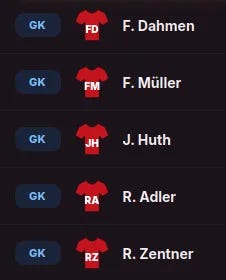
Apparently Mainz 05 have all five of these keepers in their squad for the 2018-19 season, which is a crazy thought to think about given how successful they all currently are/were throughout their career. What makes it better is that, besides from René Adler, who was obviously way past his best in 2019, the remaining four keepers all graduated into the first team from Mainz’s own academy, which is a testament to their academy work.
As for where they currently are after the 2025-26 season:
Finn Dahmen is currently Augsburg’s first choice keeper, and after a terrific season, he is now a German international and has been in and out of Germany’s squad lately.
Florian Müller managed to establish himself as Mainz’s first choice very early on, then got a move to Stuttgart and Freiburg later in his career. Where Müller fell short was he just never proved to be a consistent keeper, having conceded more goals than his peers and made errors here and there. At least he is now happy as Freiburg’s backup keeper alongside Jannik Huth, who was also from Mainz’s academy at the same time when Müller broke into the first team.
Huth enjoyed a fairly successful period with Paderborn in the 2. Bundesliga, and got a move back to the top flight with Freiburg two seasons before Paderborn’s promotion last season.
Finally, Robin Zentner has been around with Mainz the longest and has been their first choice keeper for a number of years, even with the inconsistency and tendency to make errors in goal.
It is somewhat crazy for me to think that Mainz went from having this keeper lineup that was full of academy graduates in the squad and unable to fit everyone in the team, to having a 34-year-old Daniel Batz, whom they picked up from third division side 1. FC Saarbrücken, in goal for most of last season. I have nothing against Batz and I do think that he is a decent keeper, but it is more of a reflection on Mainz’s academy recently, especially for an academy who also produced Loris Karius previously.
Yes, it is easy to make fun of Karius for the fact that he made two crucial errors for Liverpool and that will be the thing that most people will remember about him. But Karius has done very well to regain his confidence back and played a crucial part in Schalke 04’s promotion back to the Bundesliga last season. It is unsure whether he will be their number 1 next season or not, though, since Schalke have signed Kevin Müller, who was Heidenheim’s starting keeper for the longest of time and even up to before last season when he lost his starting spot to Diant Ramaj.
Going back to Mainz, however, it seems that Urs Fischer will be backing Zentner in goal for another season after Batz left for Gladbach. Mainz also currently do not have a good backup keeper heading into next season, which I assume they are currently searching for one during this transfer window. It will be interesting to see whether the club will find a long term first choice keeper and see Zentner as a backup, or find a decent backup for Zentner like they did with Batz instead.
2021-22 Hertha’s disastrous strikers lineup
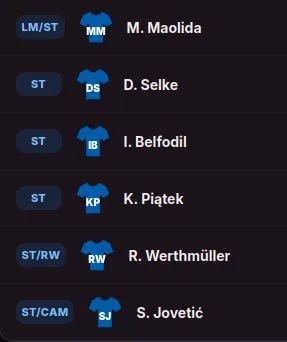
Hertha Berlin have always been a basket case of a team in the Bundesliga. They play at the Olympiastadion, which is Germany’s national stadium, yet their performance just never lived up to the level that many people expected them to be at. This strikers lineup from their 2020-21 season is probably a good reflection of their most recent seasons in the Bundesliga and why they deserved to be relegated.
Ruwen Werthmüller just got caught in the crossfire here so I will spare him from my judgement, but everyone else in that lineup was so bad during that season. Altogether, they scored a whopping…*checks stats*…17 goals in the Bundesliga, with Stefan Jovetić led the goalscoring chart for 6 goals and was followed by Ishak Belfodil with 5 goals. To put things into perspective, Anthony Modeste alone scored a total of 20 goals for Köln that same season and Taiwo Awoniyi was only two goals short of 17 goals for Union Berlin. When even players who were not traditional strikers like Grischa Prömel (8 goals for Union Berlin) and Masaya Okugawa (8 goals for Arminia Bielefeld) scored more goals than all of Hertha’s strikers, you know how bad their recruitment was.
This was also coming off the back of huge investments being made into the club and Fredi Bobič was signed to be their managing director after a very successful period with Eintracht Frankfurt. Yet they only finished that season in 16th, was saved from relegation by winning the playoff matches, then immediately went down as the worst team in the top flight the season after.
The circumstances for when that group of strikers came together was also a reflection of Hertha’s terrible recruitment at the time:
Myziane Maolida was probably signed as a promising youngster from Nice, but he never really stood out for the French side despite playing fairly regularly for Nice. There was nothing that would suggest at the time that Maolida would find his breakthrough at Hertha.
Davie Selke was signed from Leipzig a long time before and he did start off his time at Hertha fairly well, but he did not hit the level that Hertha expected him to be. He was sent out on loan to Bremen for two seasons with little to no improvement before coming back and remained at the same level for the 2021-22 season with Hertha. At least he finally found a bit of success with Hamburg by leading them back to the Bundesliga before securing a move to Türkiye with İstanbul Başakşehir.
Ishak Belfodil was somewhat similar to Selke, he enjoyed a fairly successful first season with Hoffenheim then his form immediately dropped off during the two seasons afterwards before Hertha picked him up. I do not know what Hertha saw in Belfodil for them to sign him as one of their strikers, only to be sold after a single season to Al-Gharafa.
Krzysztof Piątek enjoyed a bit of hype early on when he grabbed the attention with his 19 goals in 21 matches for Genoa then managed to carry that form over to Milan when they brought him. But his second season with Milan was a disaster and he arrived at Hertha with little to no confidence, which did not help him when the pressure was placed on him to lead the line for Hertha. His last season in Germany’s capital city saw him scored 1 goal in 10 matches before heading to Fiorentina on loan. At least he has also found some success with Başakşehir before heading to the Middle East with Al-Duhail, which might have prompted the club to sign Selke as his replacement.
Finally, Stefan Jovetić was already way past his best when he came to Hertha from Monaco for the 2021-22 season. The little bit of quality was still there as he managed to score 11 goals in total for Hertha throughout the two seasons when he was with the club. But it was definitely not enough and not at the level that Hertha had hoped he would be.
Maybe Bobič had hoped to replicate the success that he had with Frankfurt, where they bought strikers with low confidence and tried to give them a second chance. That plan definitely backfired heavily as many of these strikers would have taken up a decent chunk of Hertha’s wage budget while underdelivered heavily.
It is hard to pinpoint why that strategy failed for Bobič at Hertha because each striker had a different reason for why they failed. Jovetić was clearly way past his best and he was probably signed to provide more experience in the team. Belfodil was a cheap deal from Hoffenheim and it was supposed to be a low risk move. Maolida was a bit more expensive but they had high hopes in him because he was a young player, yet they still somehow made a lost when they eventually sold him. Selke arrived way before the 2021-22 season, but I assume instability and inconsistency with the playing style and managers must have hurt his ability to adapt. Piątek was supposed to be the big move for Hertha and one that they had high hopes on, but a playing style that did not suit him might have done the damage as well.
One good thing about Hertha since they went down to the 2. Bundesliga is that they have given more opportunities to their academy graduates, and that have somewhat yielded results. Kennet Eichhorn, Ibrahim Maza (Leverkusen), and Tjark Ernst (Feyenoord) are only three of Hertha’s academy graduates who have received regular playing time in the first team, then secured a move elsewhere for decent money. Their current squad also consists of many academy graduates like Márton Dárdai, Linus Gechter, Julian Eitschberger, Pascal Klemens, and Marten Winkler, some of whom also have the potential to play at a bigger club. It is definitely a good change in approach instead of constantly throwing money out of the window, they just need to find a better balance between buying players who can improve the quality of the squad and giving their academy players the opportunity. At that point, they can aim for a return to the top flight while being sustainable and can stay clear of relegation for a long time.
Guus Til’s forgettable single season with Freiburg

I was somewhat surprised to see the name Guus Til popped up when I was asked to draft a player from Freiburg’s 2020-21 squad, which then prompted me to research on why Til failed to make an impression at Freiburg. My curiosity was fueled even more knowing how good of a player he is now after returning to the Netherlands with Feyenoord and PSV. It would have been great to see Til teamed up with Vincenzo Grifo and Ermedin Demirović to form an amazing attacking trio for Freiburg and went on to make a huge impression in the Bundesliga.
After two average seasons in Russia with Spartak Moscow, Til made his way to the Bundesliga with a loan move to Freiburg, with a potential second year extension. It was meant to be a restart for a once promising young midfielder who was part of a very exciting AZ Alkmaar team. The two seasons in Russia seemed to have affected his confidence a bit, and with Russian teams being excluded from playing in European competitions, it was the right moment for Til to move closer to home with Germany not that far away from the Netherlands.
Freiburg also seemed like a good destination for Til as the club were finding their footing among the European challengers pack in the Bundesliga. Under legendary manager Christian Streich, the club went from strength to strength since escaping their status as a yo-yo club who bounced between the 2. Bundesliga and the Bundesliga. They constantly challenged for a European spot and were aiming to take the next step by qualifying for the Europa League. That, combined with the fact that they were about to move to their new home Europa-Park from the Dreisamstadion, signalled a very bright future for the club, a future where Til would be a key player for the team.
But one thing that sports in general have taught me is that it is still possible to fail when you are at the wrong place and in the wrong time. Freiburg was definitely not the wrong destination for Til, he seemed to have embraced the environment within the club and the city itself. But the timing of the move was very wrong, which limited him to just 7 matches in the Bundesliga for Christian Streich’s side.
An ankle injury kept him out of the team until November 2020, when he made his debut for Freiburg when he came on at the 88th minute for French midfielder Baptiste Santamaria. Even then, he was used very sparingly and was mostly on the bench afterwards as other midfield options like Santamaria, Nicolas Höfler, Jeong Woo-yeong, or Janik Haberer were favoured ahead of Til. He had to wait until March 2021 for his full debut against Augsburg, but he did not get to play the full 90 minutes either.
It is also important to remember that all of this happened during the Covid pandemic, where teams had to play without fans and with the expectation that the season could be stopped at any moment. A lot of disruptions definitely did not help Til settled in quickly after recovered from his injury, which prevented him from making any impact when he had the opportunity. But it was still possible for Freiburg to see his quality as he appeared in 4 matches for their B team in the Regionalliga and managed to score in 3 out of 4 matches. This Freiburg B team were not a bad team either as they had a lot of players who would eventually become staple players in the Bundesliga and 2. Bundesliga like Noah Atubolu, Killian Sildillia, Keven Schlotterbeck, Luca Itter, Yannik Keitel, Enzo Leopold, Noah Weißhaupt, and a young Kevin Schade.
None of this were in Til’s plan when he first moved to Freiburg, and I am sure that he was not able to control any of these external factors. There was no doubt that if it was a bit earlier or a bit later, Til would have potentially become a good player for Freiburg like he is right now for PSV. But that single season that he spent with Freiburg is a good lesson for player recruitment.
A player can love the destination where he will be moving to, be able to gel with new teammates, and suit his new team’s playing style. Yet, if the timing of the move is wrong and there are external factors that can affect the outcome of the transfer, then that transfer will fail nonetheless. This is why it is still fairly hard to judge whether a transfer is a success or a failure just by looking at a player’s on-field performance or their data alone. There are a lot of external factors that can affect a player’s adaptability to a new team, and those non-football factors are still quite hard to be quantified using data, for now.
As much as football are trying to be data-driven or even AI-driven as technology gets better over time, it is still important to remember the human aspect at the heart of the sport. A player or a coach’s performance can be influenced by their relationships with the club’s front office, their family situation, their adaptability to a new environment, things that players or coaches do not share very often during press conferences or interviews. It is impossible to remove or neglect those factors from football, because if one does, then they are setting themselves up for failure. As a result, it will open up opportunities for other clubs to capitalise on and turn that failure into a success.
As mentioned at the beginning of this article, this is a very random article that might just be a one-off. I understand that many people prefer to read well-structured, in-depth, well-researched articles about tactics and scouting and whatnot. That will continue to be my focus whenever I have a new idea that I want to work on. But, occasionally, I will have these random articles where I look back at football’s past with hindsight and see what can be learned from the successes or failures of teams and players.
I think it is always important to look back and respect the past because without the past, there will be no future. Football have had its fair share of successes and failures in the past, and there is at least a lesson to be learned from any of those. I also know that my opinions do not really matter that much, but I still want to write these for my own future references and maybe it will inspire someone to form their own opinions on how to change football.