

How similar are football substitutions and Formula 1 pit stops?
A lot, actually, and both can also be predicted using data...to an extent!
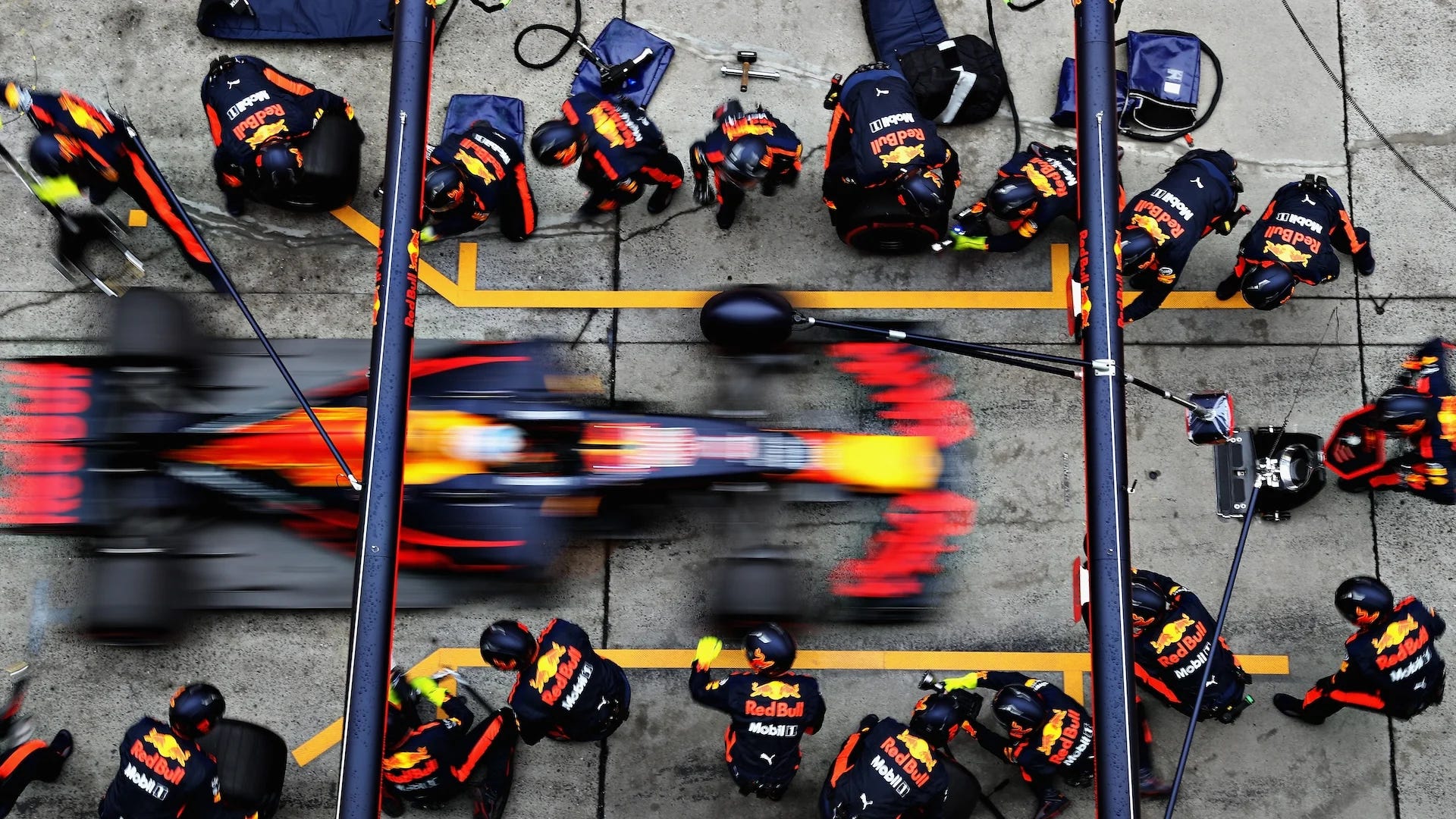
That is not a question that I thought my brain would come up with a while back. But after moving past the stage of casually following Formula 1 a few months ago and starting to follow more closely and learning more about the intricacies of the sport (not because of Drive to Survive, have to get this out!), I learn that Formula 1 is an extremely data-heavy sport. As a data nerd, that just sounds like music to my ears. But instead of trying to answer that question with all of the high-level language and knowledge that I have learned about data science, I like to keep things a bit fun and easy to understand. So, this article is my attempt to gather all of my research notes and answer the question in the most light-hearted way possible.
Overview
Core Similarities
Shared Similarities
Decrease in Performance Over Time
In F1, each tyre compound (as labelled below, plus the intermediate (green) and wet (blue) tyres for wet races) performs differently to each other. But as the race goes on and the tyres experience more wear, the car goes slower lap by lap.
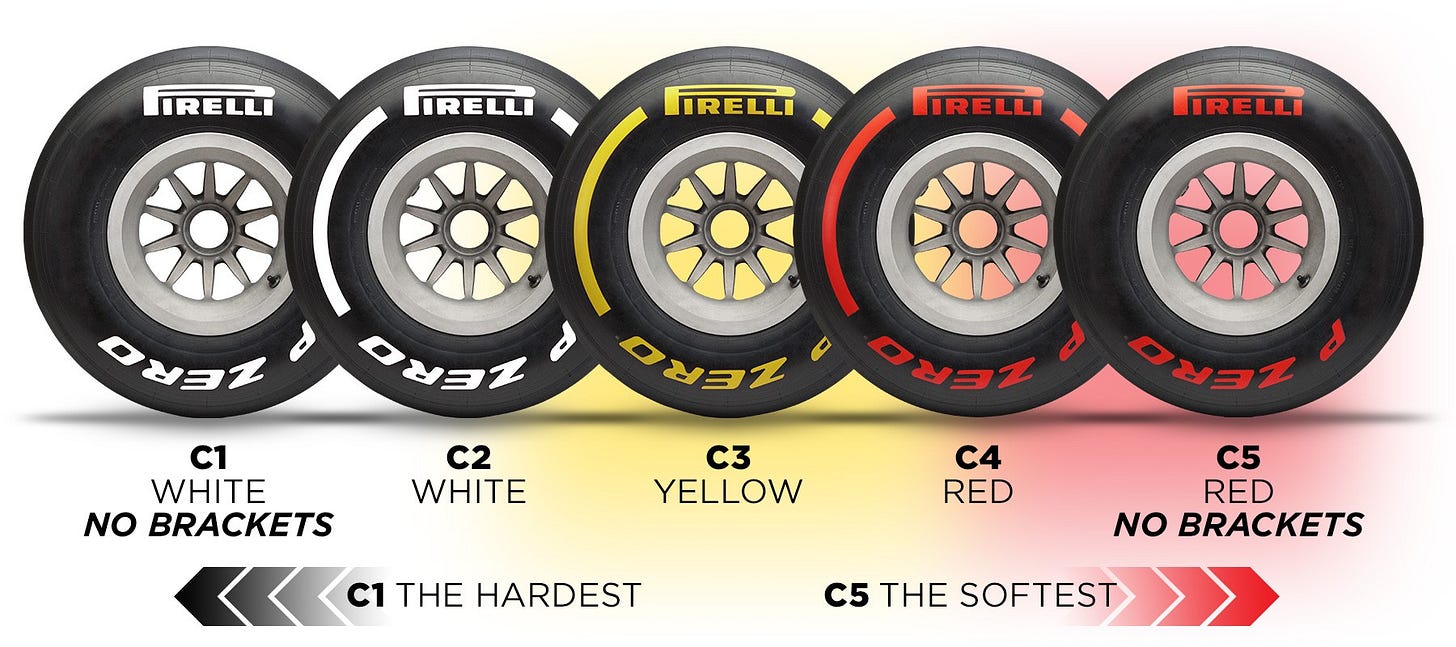
Image: Newsroom Pirelli In football, as players run more, run faster, and make more sprints throughout a match, they will get tired as the match goes on, especially after the 60th minute.
Optimal Timing
F1 teams use undercut/overcut (pit before opponent/stay out when opponent pits) strategy to identify the ideal pit lap in order to balancing tyre life and their current track position.
Football teams can also ask a similar question: at which minute does a substitution make the most impact? Research consistently shows subs made before the 60th minute yield more value than later ones because players need time to warm up (physically and mentally) and adapt to the current state of the match before using their ability to influence the match.
This actually mirrors the performance lifetime of an F1 set of tyres after a pit stop. The tyres start out cold and need to be warmed up, thus why drivers tend to do a warm up lap before achieving their fastest lap on a set of tyres that reaches optimal temperature during qualifying sessions or even during the race to gain track positions.
Performance Before vs. After a Pit Stop/Substitution
Both sports attempt to answer the question: did the intervention improve outcomes and results?
F1: pace before pit vs. pace after on fresh rubber.
Football: xG generated, pressing intensity, or defensive coverage before vs. after the sub.
Strategic vs. Reactive Interventions
Both can be pre-planned (a known two-stop strategy; a planned tactical sub at half time) or reactive (safety car window; an injury or red card), which can be simply deducted down to whether the intervention was planned or forced.
Profile/Compound Matching
F1 teams chooses which tyre compound fits the track conditions and remaining race distance.
Football teams chooses which player profile fits the tactical need, like a fresh striker to chase the score, or a defensive/holding midfielder to protect the lead.
Essentially, teams from both sports need to optimise the resources (players/tyres) that are available to them while taking into account their current situation in a race/match.
Window of Opportunity
F1 teams exploits virtual or full safety car periods, which are low-cost windows to pit without losing or losing the least track positions.
Football managers exploit dead ball situations (throw-ins, goal kicks, corners, free-kicks) or injury delays to minimise disruption and momentum.
Both can be seen as opportunistic timing relative to game/race events.
Compounding Effects
Pitting two cars on the same lap has coordination costs for the pit stop crew and increases the risk of the crew or the driver making mistakes.
Multiple football substitutions at once have a similar dynamic. They can be beneficial for fresh legs, but risks disrupting team shape and communication.
Nuances
Reversibility: Theoretically speaking, F1 teams can immediately pit again and football teams can bring off the same player who was subbed on. However, these are considered forced interventions because they are unplanned and only happen when something has gone very wrong, like:
F1 teams need to pit again on the next lap due to a damaged component (usually front wing or body works) or a tyre puncture caused by contact on the track.
Football teams need to sub off the same player who was subbed on because of a severe injury or an immediate tactical change to react to what has happened since the player came on.
Human variability: A fresh tyre performs predictably, while a substitute player introduces psychological and form variability that’s much harder to model.
Disruptions:
In F1, pit stop strategy can be disrupted if the pit entrance/exit is closed due to various reasons (see Melbourne GP 2026, Valtteri Bottas’ retirement).
In football, theoretically, it’s not possible to prevent a team from making substitutions by blocking the touchline. Although, it can be delayed by keeping the ball in field as long as needed.
Game state dependency
What is a ‘State’?
State is a snapshot of all variables that influence the value of an intervention at a given moment.
How does a pit stop/sub depend on race/game state?
A pit stop or substitution is never evaluated in isolation - it’s evaluated relative to what the current situation in the race/match allows and/or demands.
In F1:
A pit stop in lap 5 under a safety car is a completely different decision to a pit stop on lap 40 in clean air, even if the tyre wear is identical.
What currently happens during a race decreases or increases the cost of stopping (track position loss is minimised under safety car, maximised during a fast stint battle).
In Football:
Bringing on a forward when losing 1-0 in the 75th minute is a completely different decision to the same sub when winning 2-0 in the 75th minute.
The game state reframes the risk that accompanies every substitution. Even with the same player, and the substitutions are made during the same window, both substitutions can bring entirely different values to a team depending on what is happening during the match and whether the team are winning/drawing/losing.
It can be easy to say that a substitution or a pit stop is made for the sake of making one. But, in reality, there are a lot of decision layers that are coupled with the final decision of why and when to make the pit stop/substitution. Without the help and/or suggestion of data, these decisions are made by football managers and F1 race strategists who have many years of experiences and they are utilising that knowledge bank of past experiences to make the call.
Where data and prediction models can help is removing the level of bias that people naturally have. It is still hard to find a balance level between rational and emotionally-driven decisions, having that bank of experiences definitely help to an extent, but even the most experienced managers and race strategists still make irrational decisions. The end goal is not to make both football and F1 more robotic because the final decision still belongs to the manager/race strategist, but to assist key decision-makers with making the most optimal decisions possible.
Going back to game state, data and prediction models can also help lower the amount of decisions that managers/race strategists have to make during a match/race. Each manager has a million things to process during a match and has to make a lot of important decisions, like tactical decisions to influence the result to go their way. The same goes with race strategists, they have to make important tactical calls that can change the imminent and final results for the team. Using data to find an optimal pit stop/substitution window is no different to having an intervention specialist who already has a lot of past knowledge and experiences on the pit wall/on the touchline.
How can race/game state influence strategy/decisions?
As a Trigger to Execute
Both decisions can be viewed as threshold problems, where teams act when the situation reaches a predetermined extreme point, like pit when tyre performance is starting to cause the car to slow down and lose track positions (for F1 teams), or make a sub when a player’s physical and on-field performance is slowing down while the team needs to chase or maintain a result (for football teams). The situation continuously updates that extreme point for every team, which essentially forces team to optimise the situation in real-time.
Cascade (one event reshapes everything)
In both sports, a single disruption can invalidate an entire strategy:
A safety car in F1 can turn a one-stop into a two-stop plan instantly.
A red card in football can turn an attacking substitution into a defensive reshaping, mid-thought.
This is what known as strategic volatility, where the current situation is not just an afterthought, it is actively influencing decisions and strategies to go in different, (sometimes) unpredictable ways. Both sports reward teams/managers who can react and make changes faster when the situation shifts unexpectedly.
Opponent Interdependency
Deciding whether to make a substitution/a pit stop or not is not just relying on everything that happen with the team themselves, but it is also reliant on what the opposition are doing at the same time. This adds an extra layer of connection to the similarity between the two actions, but also adds complexity to the task of predicting when to make the call.
Take these two scenarios as examples for how opponent’s decisions also link to deciding when to substitute or make a pit stop:
In F1, if an opponent driver pits, a team may be forced into an early pit stop to cover the undercut even if their tyres aren’t ready.
In football, if the opponent makes a substitution that changes their shape, it may force a reactive sub to restore a tactical matchup.
Conclusion
A good decision in the wrong state is worse than a mediocre decision in the right state.
For both sports, it is less about what to do, and more about when the situation makes it worth doing. There is also no ‘perfect’ strategy when things do not happen as planned, and that is usually most of the time due to the randomness of both football and Formula 1 (even though they are on different levels of randomness). There are simply so many factors that can alter the pre-planned strategies, like game state and other factors that will be discussed below. So, teams can only plan their strategy to an extent and have to be ready to react to external factors that can happen while a race/match is going on.
Performance decay
What is ‘Performance decay’?
A big word, I know, but it simply describes the question ‘how does a unit’s performance decrease over time’. In even simpler words, ‘why does a player perform worse as the match goes on/a car runs slower as the race goes on’. Using the earlier example as a simple way to explain the word:
In F1, each tyre compound performs differently to each other. But as the race goes on and the tyres experience more wear, the car goes slower lap by lap.
In football, as players run more, run faster, and make more sprints throughout a match, they will get tired as the match goes on, especially after the 60th minute.
As mentioned above, a decrease in performance is never a straight line and can depend on various factors, game/race states included. Human performance is still limited by how well each person treats their own body, and while professional athletes can perform at a high-level for a longer period, they also have a threshold where they become more vulnerable to injuries. The same goes with tyre performance, with the limiting factor simply being our good old physics friend, friction. Unless F1 turns to cars that drive using magnetic fields, which might happen in the distant future, tyre degradation is still one of the most important factors that teams have to take into account. Other factors include…
How can strategy and tactics influence performance decay?
Strategy and tactics don’t just respond to decay - they actively determine its shape and rate.
In F1…
Driving Style
A driver’s inputs and driving style directly influence how fast a tyre degrades.
Aggressive corner entry, high lateral G-forces, and hard braking zones (see Max Verstappen’s driving style) all generate heat and wear on the rubber thanks to our good friend friction.
A driver told to “manage the tyres”/”more LiCo” (lift and coast, or lower speeds into corners, smoother throttle application) can extend tyre life by 10–20 laps on the same compound.
This means the same set of tyres and on the same compound can have completely different performance depending on the driving instruction given by the race engineers, strategists and the driver’s own driving style.
Fuel Load Strategy
Teams who start the race with more fuel than needed to complete the race can increase the stress on their set of tyres, which means the car is harder to manage, degradation is higher early. By doing this, basically, teams change the performance curve of their tyres right on the first lap.
Race strategists overcome this problem by suggesting their drivers to drive aggressively during the early laps to utilise both the extra fuel and fresh set of tyres to gain as many track positions as they can before performance starts to drop. They can also choose to be cautious early to extend the lifetime of the first tyre set and shift the pit stop window to later than their opponents.
Track Position vs. Tyre Management Trade-off
Running in dirty air behind another car forces higher downforce loads and more tyre sliding to maintain lap time, which means lowering the tyre performance at an higher and faster rate. Meanwhile, a strategy that prioritises clean air actively reduces the rate of tyre wear even at the cost of track positions in the short-term.
Tyre Compound Choice
A softer tyre compound means faster pace at the cost of performance decreasing much faster. In contrary, a harder compound maintains its performance for a longer run, but takes longer to warm up, reaches optimal performance later, and the car reaches its maximum pace later.
In Football…
Pressing Intensity
This is perhaps the most direct parallel to tyre degradation. High-pressing systems (see Liverpool under Klopp, or Leeds under Bielsa) place extreme physical demands on players, particularly in terms of the total distance that players have to constantly run at high speed, or high-intensity sprint distance. Data consistently shows that pressing metrics drop sharply after 60–70 minutes in high-press teams, far more than in low-block (see José Bordalás’ Getafe) or possession-based sides. Choosing to press throughout the pitch is like choosing a soft compound in F1, where teams aim to extract maximum early performance, but at the cost of slowing down and experience decrease in performance much earlier.
Possession-Based Style
Teams that dominate possession (see Guardiola’s Barcelona and Manchester City) naturally regulate the physical output of their players, which means lower sprint distances, more walking/jogging phases, controlled tempo. This is the football equivalent of an F1 driver being told to manage tyres through smooth inputs. The decrease in performance happens later and allows players to remain effective deeper into the match because the tactical system conserves energy.
Positional Demands
Not all players experience a drop in performance at the same time. A manager’s tactical shape essentially assigns different performance drop-off points to different positions, which should directly inform the substitution priority order.
Full-backs who like to make overlapping/underlapping runs cover enormous distances, thus their performance decreases faster than centre-backs in the same team. They, along with wingers/wide midfielders tend to be substituted the earliest.
Central midfielders in high-press systems are the most exposed to early fatigue. They can also be placed high up on the substitution priority list having covered the most distance compared to other teammates (see Arminia Bielefeld’s Mael Corboz).
In-Game Tactical Adjustments
Dropping into a mid or low block when leading is the tactical equivalent of telling a driver to “back off and manage” because it reduces the physical load for the players and extends their effectiveness. Conversely, pushing for an equaliser by increasing pressing intensity late is like pushing a set of tyres past its optimal window, where teams extract short-term performance at the cost of rapid loss of fitness.
How can external factors influence performance decay?
External factors don’t just influence performance - they fundamentally rewrite the decay function itself, often before a wheel has turned or a boot has kicked.
Weather Conditions
Track temperature is the primary driver of tyre behaviour because rubber operates in a narrow thermal window. Too cold and it doesn’t activate (graining, no grip), too hot and it degrades rapidly (blistering, thermal degradation). A 10°C swing in track temperature can shift the optimal tyre compound entirely, invalidate a pre-planned strategy, and compress or extend the performance window of a given tyre by significant lap counts.
Similarly, in football, heat and humidity also rapidly increases the loss of performance in football. High temperatures elevate core body temperature faster, increase stress on the heart, and measurably reduce sprint frequency and distance covered particularly in the second half. Studies from tournaments in hot climates show high-intensity running drops by 15–20% in extreme heat, meaning the team’s effective pressing range shrinks significantly faster than in temperate conditions.
Football players are also limited by cold conditions that can actually suppress muscle performance and increase injury risk, particularly for hamstrings and hip flexors. This creates a different type of performance loss where the risk of sudden performance loss (injury) rises sharply rather than a gradual fade.
Rain is the most dramatic disruptor for both sports because it introduces an entirely different performance loss curve. Wet tyres have their own wear curves, and the transition window (when to switch from intermediates to wets or vice versa) is one of the highest-stakes decisions in F1 precisely because the loss of performance for wet and dry compounds are completely different from each other. Meanwhile, footballers experience heavier legs and increased injury risk from slipping when playing in a rainy condition and on a wet pitch. This makes a faster, more direct style of play becomes both more likely and more physically demanding.
Wind direction and speed affects aerodynamic balance corner by corner. For example, a tailwind on a straight changes braking points, increases tyre stress in specific zones, and creates uneven wear patterns across the four tyres. Wind also affects technical quality in football since long passes, crosses, and shooting accuracy all degrade in strong wind, indirectly forcing teams into shorter, more energy-intensive passing patterns.
Venue Characteristics
Each Formula 1 circuit brings a different challenge to teams due to the design and characteristics of the venue itself. High-downforce circuits like Monaco and Hungary allow for a balanced tyre wear across all four tyres, while high-speed circuits like Silverstone (England) or Spa (Belgium) place more tyre wear on the front-left due to the number of high-speed right-hand corners, all of which create a different performance loss curve unique to that circuit. Street circuits like Monaco, Baku, or Singapore introduce even more and faster tyre wear and graining (where the rubber surface tears before it heats properly) due to the imbalance between abrasive and smooth surfaces.
Footballers experience a similar problem when they play at different stadiums and on different turfs. A poor, bobbly pitch disrupts passing rhythm, increases the energy cost of ball control, and forces more physical duels. Conversely, a pristine surface enables the fluid, low-energy possession play that conserves player output. Artificial turf also increases the loss of performance because it encourages teams to play faster, increases joint impact forces, and is associated with measurably higher rates of soft tissue injury.
Altitude is the one common problem for both F1 and football. Take Mexico City for example, F1 teams experience a decrease in aerodynamic downforce because of thinner air. As such, teams run higher wing angles to compensate, which increases drag and changes the thermal load on the brakes and tyres in ways that require entirely new ways to model loss of performance. Meanwhile, Bolivia’s La Paz is football’s infamous example of how playing at a higher altitude shows measurable drops in aerobic performance, with players reaching fatigue thresholds significantly earlier. Visiting teams who haven’t acclimatised show steeper, earlier decay curves than home sides.
Scheduling & Fixture Congestion
For F1 teams, sprint weekends compress the preparation and prevent teams from have more practice data to predict their performance drop-off points, introducing greater uncertainty into strategy. Back-to-back race weekends also affect team personnel fatigue and car preparation quality, which can indirectly influence strategy execution.
Meanwhile, fixture congestion is one of the most frequently discussed topics in modern football. A team playing its third match in seven days and having to balance between both domestic league and domestic/continental cup competitions arrives with players whose baseline fitness is already suppressed. Because of that, the loss of performance doesn’t just happen quicker, it is also earlier because recovery is incomplete. Accompany that with travel fatigue where a team have flown internationally and crossed time zones decreases player performance at a much, much faster rate and players begin the match with a depleted baseline.
This forces football teams to have to plan and strategise thoroughly, including changing the optimal substitution strategy during a match. Teams and managers have to rely heavily on the quality of their starting XI and squad depth to navigate the loss of physical performance due to fixture congestion and travel fatigue while minimising the loss of performance on the pitch. Again, this is pretty much an optimisation problem that teams have to deal with every season.
Conclusion
The external layer essentially argues that decay is not a property of the car or the player. It’s a property of the car or player in a specific environment.
Relying on pre-match and aggregated data alone is not enough because deciding when to make a pit stop/substitution is not only constrained to what happened in the past and how teams have prepared. There are a lot of external factors that can also change the optimal strategies that a team have planned, which can only be predicted to an extent before the match and teams have no control over them.
Overall conclusion
This started out as a normal, naive question where I question how two intervene actions in two different sports can be similar to each other. tl;dr, the answer is yes, they are, surprisingly, very similar to each other. But as I went deeper down the rabbit hole, I also peeled back each decision layer that sports professionals have to make before deciding whether to make a substitution/a pit stop or not. I am quite sure that I am only scratching the surface level of this topic, but at least it has given me an idea and a challenge to do in my free time, so maybe keep an eye out for that!
Imagine comparing the tactical thought process of the people who make those decisions in F1 to football, or vice versa? Applying one to the other - what impact will that have? A fresh mind and new ideas could be good for the game, the ability to juggle all the factors and plan reactively on the spot varies across sports but maybe...