

One question for each ASEAN team in 2026: Group A
After the conclusion of the 2026 Battle of the SEAblings group stage, what is one lingering question that each Group A team are trying to find an answer for?
After four thrilling matchdays, the 2026 ASEAN Championship group stage has reached its conclusion with Vietnam and Singapore securing their semi-final spots from group A. This tournament also kickstarts a very busy period for Southeast Asian football with the first edition of the FIFA ASEAN Cup starting in September and the main event, the AFC Asian Cup, kicking off in January next year.
As such, many teams see this tournament as an opportunity to call up new players and test out new ideas ahead of more important tournaments with higher stakes and prize money. So, after the group stage, what have we learned about the teams in group A and what is the one lingering question that they are trying to answer before the Asian Cup?
Indonesia’s strikers dilemma: Mitchell Baker, Jens Raven, or Rafael Struick?
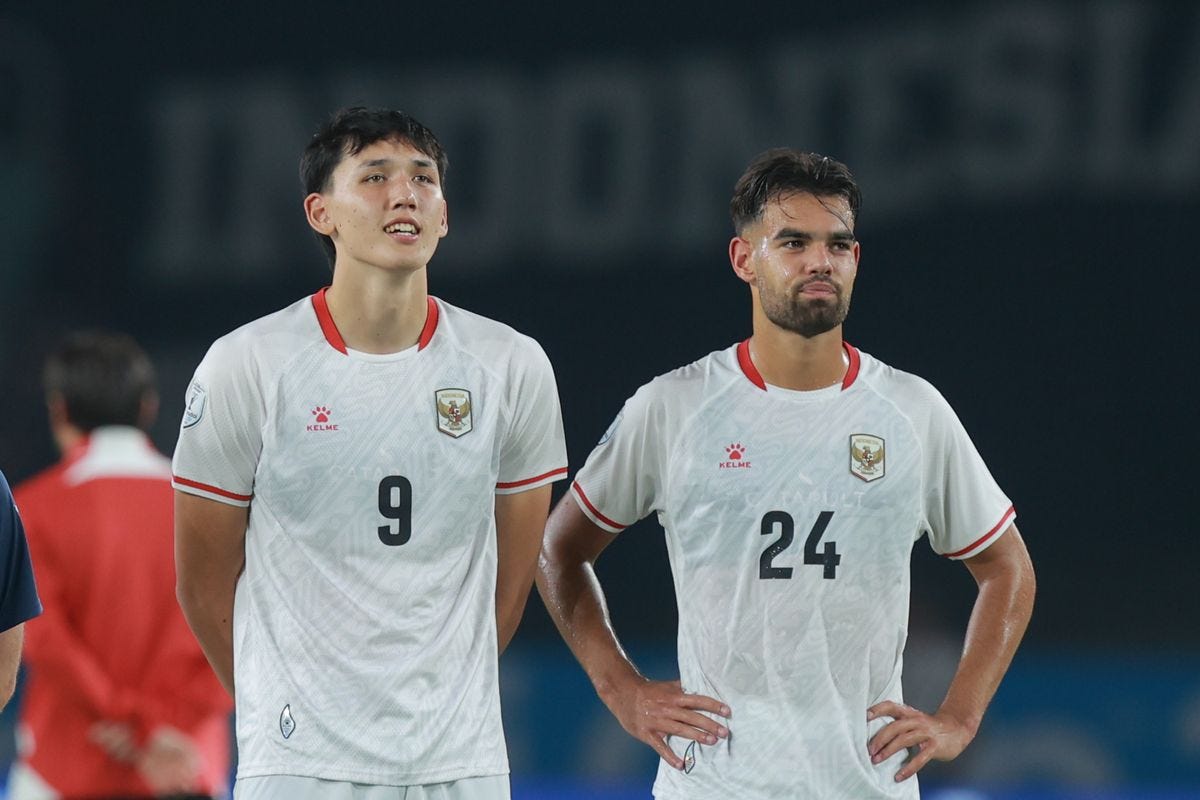
After missing out on qualification to the 2026 World Cup, Indonesia have continued their push to naturalise players with Indonesian heritage across the world. They have laid the foundation through a group of players with European experience, many of whom will continue to play at many top European leagues for the foreseeable future. But some of Timnas’ recent debutants might signal a shift in approach as Indonesia are looking towards the future by targeting younger players, players like Mathew Baker (17), Luke Vickery (20), or Adrian Wibowo (20).
While Mathew Baker only made the preliminary squad for this year’s ASEAN Championship, Wibowo was not called up as he secured a loan move to Austrian side Wacker Innsbruck, and Vickery is still waiting for his debut with the national team, one player that took this year’s tournament by storm was Australian-born striker Mitchell Baker. Colorado Rapids’ first-round SuperDraft pick was an unknown to the rest of the region prior to the tournament as he was still playing college football for Georgetown Hoyas as of writing. But if his record in college was a warning and a taste of what to expect from Baker, then 18 goals in 42 appearances should have been enough to understand why John Herdman gave an uncapped 19-year-old the number 9 shirt for this tournament.
He did not waste any time to leave his mark either, scoring a hat-trick in his debut against Cambodia and finding his fourth international goal in Indonesia’s 3-0 win over Timor-Leste. The four goals that Baker scored highlighted a natural instinct for goals and the raw quality that the Rapids must have seen in him to make him the 10th pick of last year’s SuperDraft.
Southeast Asian defenders tend to be very fearful of attackers who are good in the air since most centre-backs from the region are not considered to be very high physically and their positioning can be poor at times, leading to aerial duels being a general weakness for most defenders. At 196cm and he will get taller as time goes on, Baker’s height advantage immediately made him an ideal target in the box for crosses, and that was what Indonesia did for Baker’s first and third goal against Cambodia.
A combination of height, timing, positioning, and especially knowing when to separate from the opposition’s defender to put himself in advantageous positions to receive crosses, which was evident in his third goal against Cambodia, helped Baker put two past Cambodian keeper Hul Kimhuy. The placement of his headers also made it harder for the opposing keeper to do anything in those two goals.
The remaining two goals were easy tap-ins, but they did not come from situations where Baker waited to be served on a silver platter. In fact, those two goals showed Baker’s good sense of timing to break Cambodia and Timor-Leste’s offside traps, utilised his pace to attack the box, and put himself in positions where he was free to receive the ball for easy tap-ins. For a tall striker like Baker to also be quick off-the-ball thanks to his long leg span, that was a total nightmare for Southeast Asian defenders to defend against. Thailand’s Patrik Gustavsson was also a good example of a dangerous striker to defend against from the 2024 edition of the ASEAN Championship.
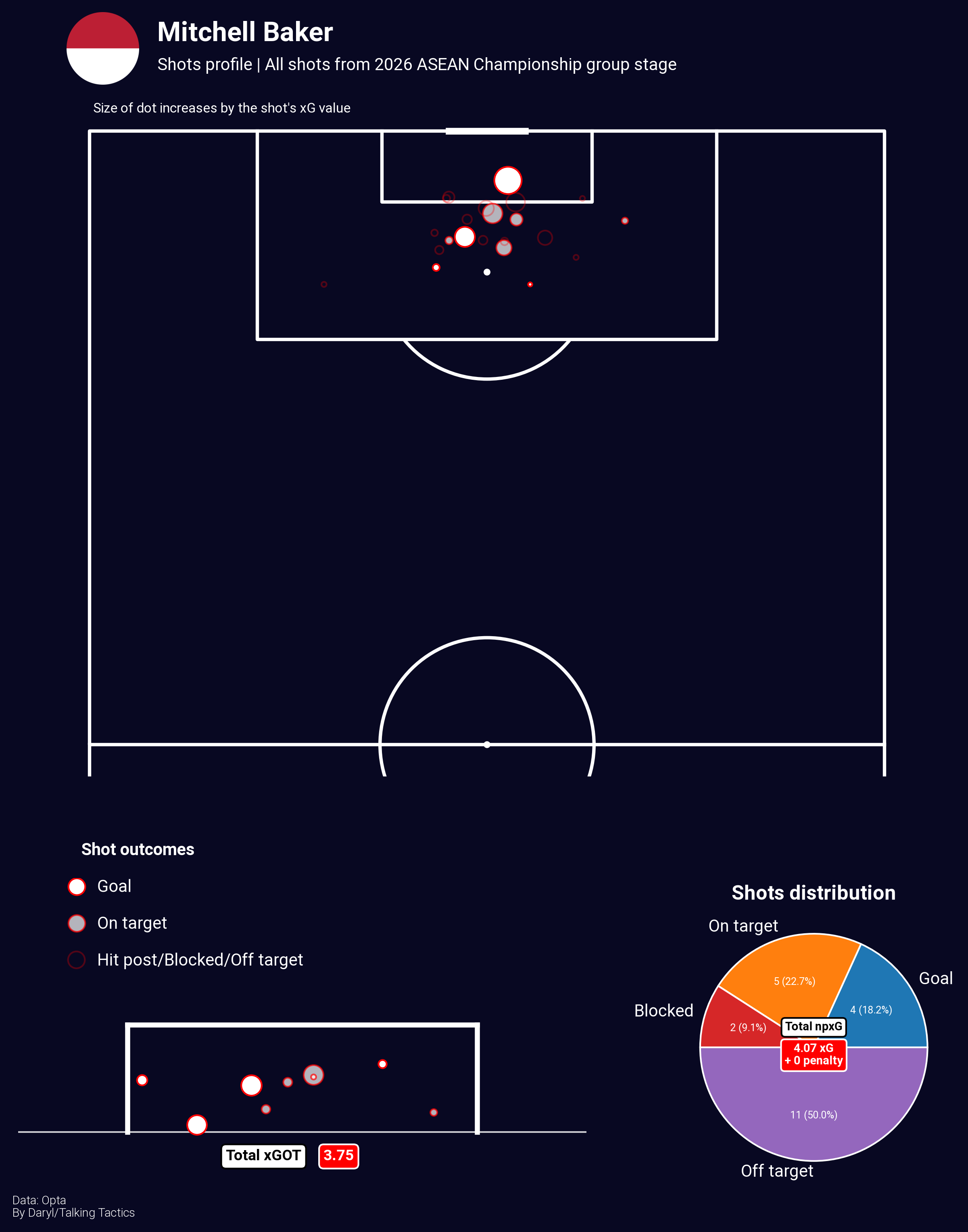
That is not to say that Baker does not have his flaws, however, because he is still very young, raw, and has not experienced a lot of professional football so far outside of his very short stint with Vermont Green in the USL League Two. Playing as the lone striker in Herdman’s 3-4-3/5-4-1 system, Baker mainly operated inside and on the edge of the penalty box. He did have a few occasions where he moved in between the opposition’s defensive lines to receive the ball, but that did not happen too often.
It made sense for Baker to be Indonesia’s dominating presence inside of the box, mainly because Herdman did call up a few players with European pedigree and were good on the ball like Ivar Jenner, Thom Haye, or Eliano Reijnders, most of whom are now playing for Indonesian clubs. With players who were good at getting the ball into the final third and into the box, Baker only needed to be at the end of crosses or passes to convert them into goals, instead of also getting involved in progressing the ball.
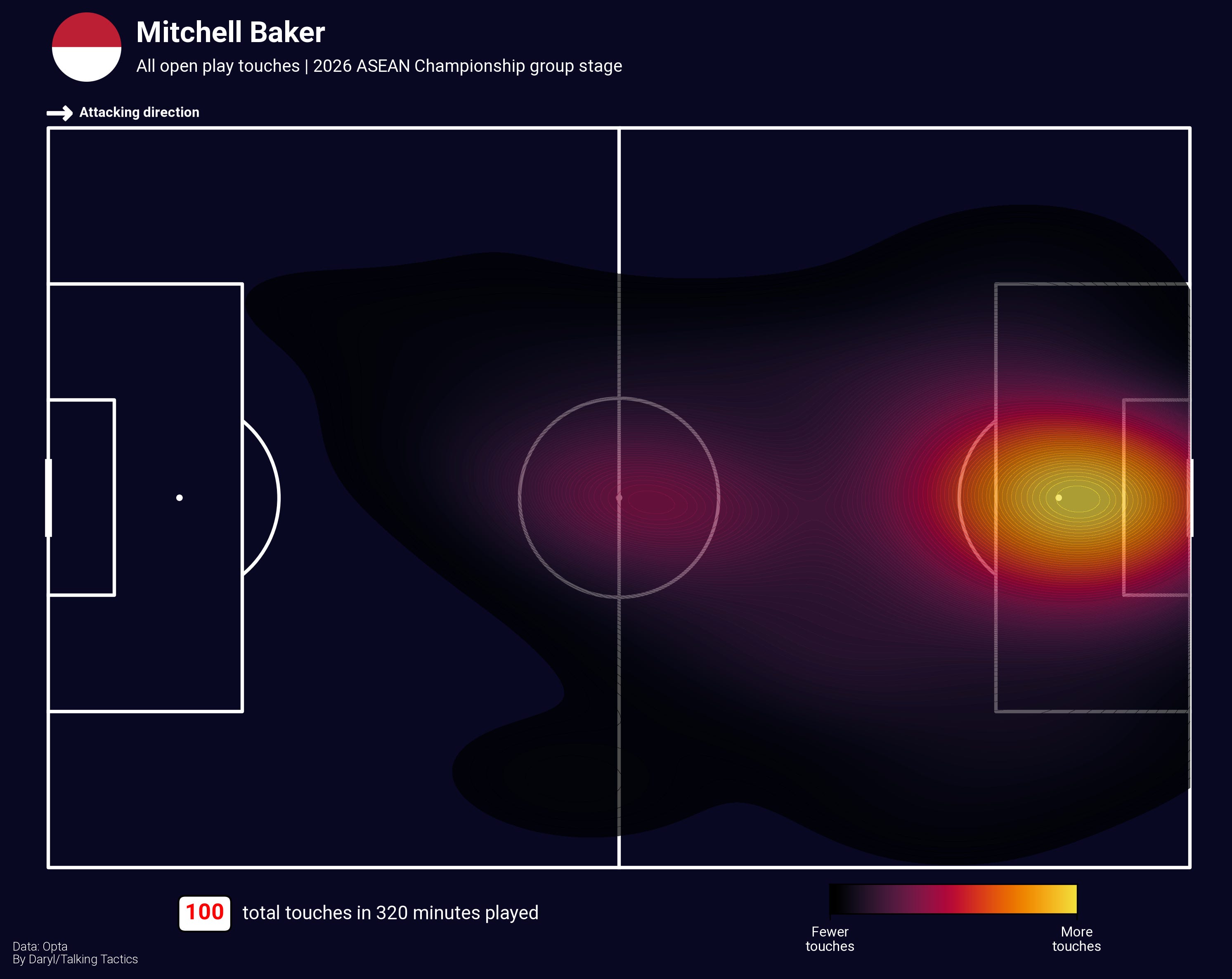
However, if the opposition can cut off supplies to Baker, then Indonesia’s #9 is isolated and cannot get involved in the game. That was Vietnam’s solution when both teams played each other in round 3 of the group stage, and it worked. Baker’s was limited to just 4 touches inside Vietnam’s penalty box and only managed to convert 3 of them into shots, a bit less than what he had against Cambodia (6 shots from 8 touches inside penalty box) and Timor-Leste (9 shots from 13 touches inside penalty box).
The fact that Baker still managed to squeeze out 3 shots from 4 touches inside Vietnam’s penalty box was quite impressive, but Indonesia’s loss against Vietnam and draw against Singapore raised a problem for Herdman and his coaching staff: have they become too reliant on Baker as their focal attacking point? Baker is a mix between a target man and a poacher who is both good in the air and is slightly quick both on- and off-the-ball, and while there will obviously be comparisons to Erling Haaland from Southeast Asian fans, Baker has not shown that he is capable of switching things up like the Norwegian striker did for Manchester City.
For a while, Indonesia struggled with goal-scoring despite the naturalisation of many attacking players. They finished the 2024 ASEAN Championship group stage with just 4 goals scored and they only scored 1.1 goals per match during the 2026 World Cup qualification campaign. They made up for their goal-scoring woes by having a strong defence, but the team have also experienced firsthand that a strong defence only got them a bit further than where they have normally been against stronger teams in Asia. The fact that Indonesia only had Ole Romeny to count on to consistently score goals did not help them a lot either, so I assume Timnas will be welcoming Baker’s emergence with open arms.
On the contrary, Baker’s emergence will have players like Jens Raven and Rafael Struick worry about their places in the national team.
Struick was part of the first naturalisation wave when Indonesia started to push heavily for such approach, and he had the most time with the national team to prove himself as one of Indonesia’s main goalscorers. Yet, after 43 appearances for the first team and the U23 side, Struick only managed to score 6 goals, a very disappointing conversion rate. At club level, Struick has not found his confidence in front of goal either, with his two goals in club football so far came against Sydney FC for Brisbane Roar in the A-League and for Dewa United against Shan United in the AFC Challenge League.
His performance at the 2024 ASEAN Championship was hardly promising either. Playing on the left of a 3-4-3, Struick did not have plenty of opportunities to attack the penalty box and find goal-scoring opportunities like a natural striker would. He also had to balance the responsibility of creating chances and bringing the team forward with his dribbles, further limiting his presence inside the box.
The fact that Shin Tae-yong opted to call up a very young, domestic-heavy team also did not help because it put Indonesia on the back foot against other Southeast Asian teams who took the tournament more seriously. Indonesia and Struick had to play more defensively and many young players looked to Struick for inspiration during counter-attacks, and that did not work out very well.


Meanwhile, Raven offers a mixture of both Baker’s and Struick’s profiles. A tall, rangy striker who has the physicality to hold up the ball and link up play, while also has a bit of pace to run in behind the opposition’s defensive line. Because of the strengths that he brings, Raven has been Indonesia youth teams’ main striker for the past 3 years or so, and his goal-scoring records for them have also been impressive, headlined by the golden boot at the 2025 ASEAN U23 Championship.
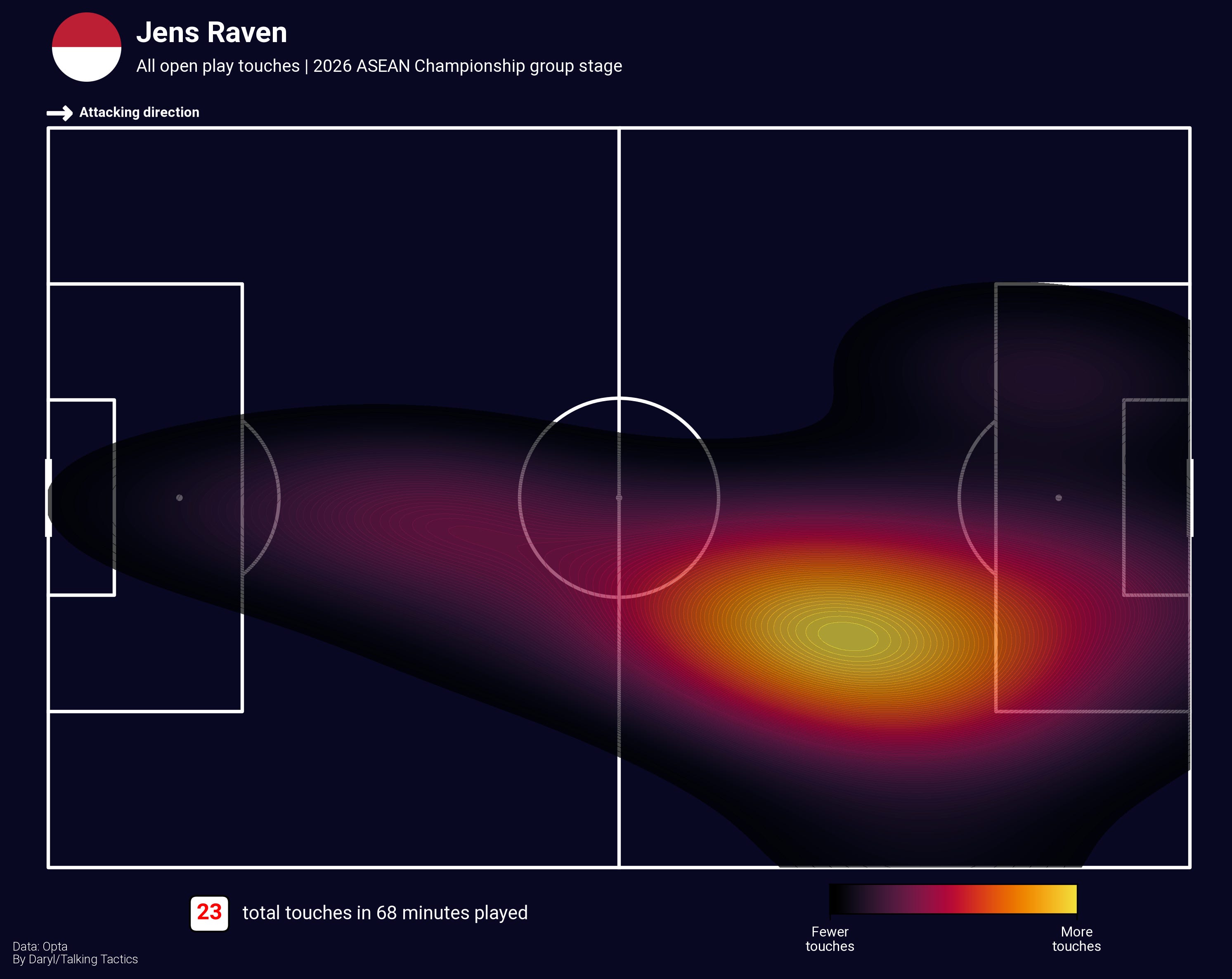
He has patiently waited for his time to step up to the first team, but Baker’s emergence and Mauro Zijlstra’s inclusion in the first team will put that ambition into jeopardy. It is hard to deny that Raven still has potential to be a decent striker for Indonesia, and he is still very young at just 20 years old. However, he needs to make the most of every opportunity, especially when those opportunities will be at a premium moving forward. His form for Bali United also needs to be improved, considering he has only scored a single goal after 24 appearances as of writing.
Going back to the original question with a bit more context, the question then becomes: who are Indonesia’s striker options for their push to next year’s Asian Cup and the 2030 World Cup? Besides Ole Romeny, who will be locking in one of the spots in the first team, the remaining spots are pretty much up for grabs. Leaving a few spots for domestic talents like Marselino Ferdinan, Egy Maulana, and Beckham Putra, and the remaining attacking spots are quite limited.
Assuming Indonesia are happy with their current attacking options and are not pushing for more naturalisation in the future, Timnas will have a plethora of players competing for the few attacking spots. If Struick can pick up his form for Dewa United and earn a move outside of Indonesia, he is more likely to be a rotational option for Ragnar Oratmangoen on the left, which seems more plausible for Struick at the moment as he is pretty much out of the running to be a striker.
Raven, however, will be in the mix for one of the spots behind Romeny along with Zijlstra and Baker. His situation will be very similar to Struick’s because he is also very young and things can still change from now until the 2030 World Cup, especially if he can earn a move out of Indonesia and stay ahead of Zijlstra and while Baker is still improving with the Rapids.
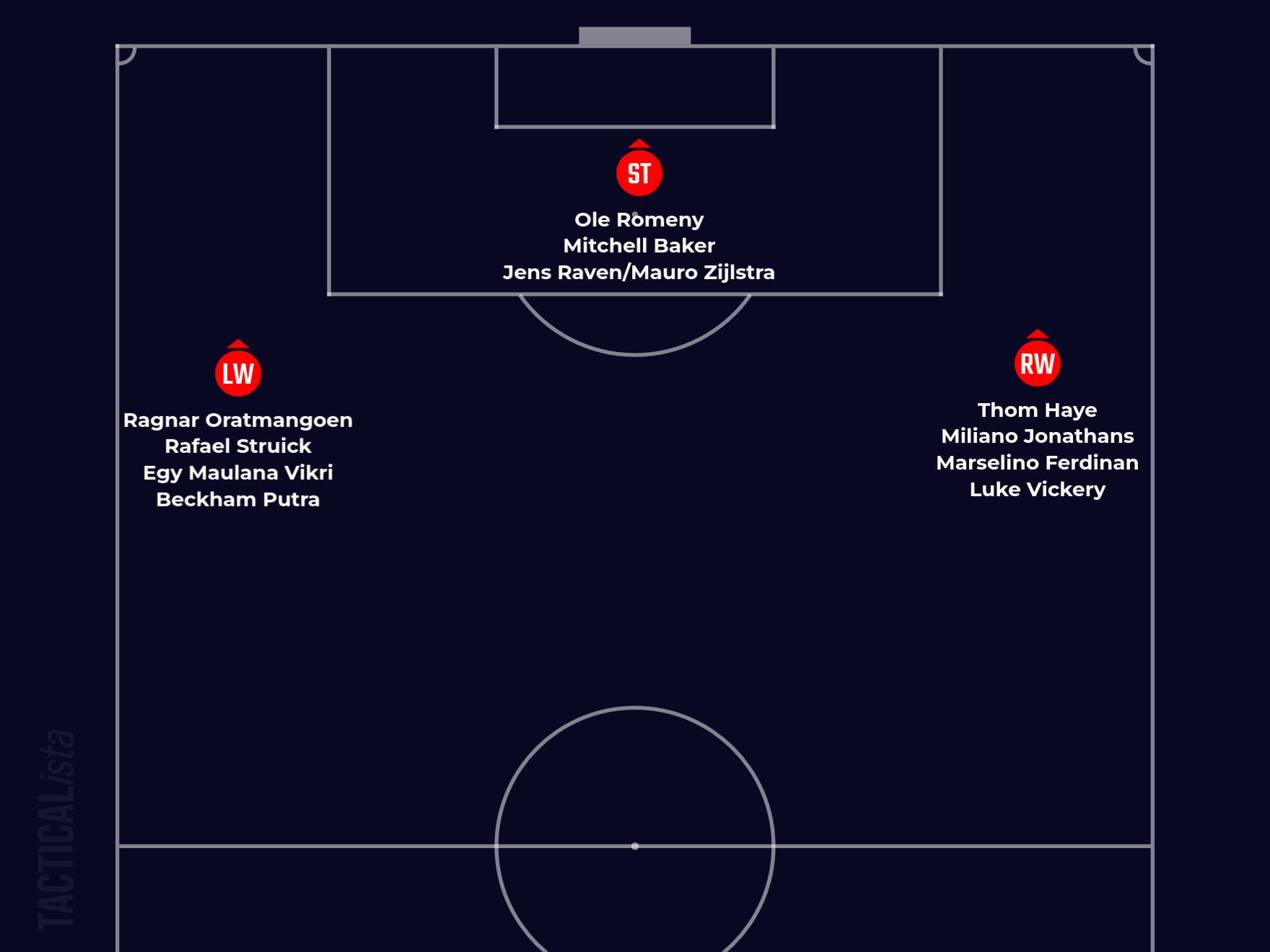
Most of what I said above are just assumptions and based on what is happening at the ASEAN Championship. Things can change from now until the next World Cup and it will change fairly quickly given how hard Indonesia are pushing to naturalise players. The emergence of Mitchell Baker during this year’s ASEAN Championship will create a hard, but good problem of squad depth for John Herdman and his coaching staff heading into the next World Cup cycle. That will mean a few players will miss out, which is the natural cause of competition, but it will hopefully give some players like Struick or Raven a boost of motivation to finally get back into form.
Is Kyoga Nakamura & Shah Shahiran the answer to Singapore’s Shahdan Sulaiman-size hole in midfield?
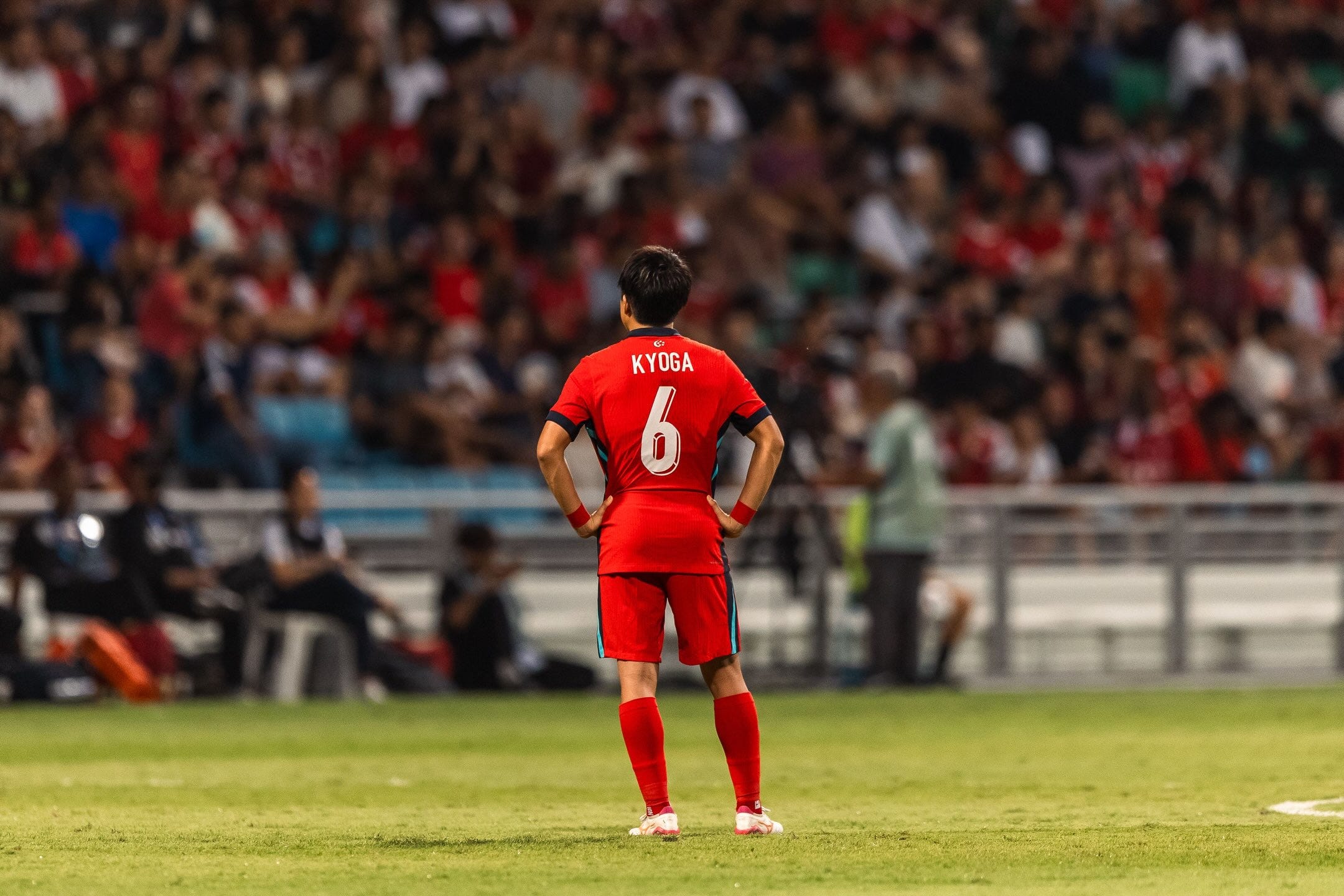
It is hard to deny that Shahdan Sulaiman is a Singaporean legend. He might not be the flashiest player on the pitch, he did not score many goals like Fandi Ahmad, Faris Ramli, or Shawal Anuar, nor did he save the team from conceding crucial goals like Hassan Sunny, Izwan Mahbud, Hariss Harun, or Safuwan Baharudin. But he was a constant in Singapore’s midfield for many years, dictating the play from deep and creating scoring chances for his teammates. For a while, he was one of the best playmakers in the region and was a bit unlucky that injuries limited him from achieving more with the national team.
When Sulaiman announced that the 2024 ASEAN Championship was his last hurrah with the national team, Singapore were already working on an answer for the future without the legendary midfielder. Among the midfield options for that tournament were Sulaiman’s long-term understudy Shah Shahiran and, most notably, newly-naturalised midfielder Kyoga Nakamura. Together, they showed a glimpse of what the past and future of Singapore’s midfield looked like, even when Sulaiman’s minutes during the 2024 tournament was fairly limited.
In Singapore’s opening match against Cambodia, head coach Tsutomu Ogura used a 4-1-4-1/4-1-2-3 formation that saw Shahiran as the midfield anchor in between the lines, while Sulaiman and Nakamura played just in front and acted as two playmakers. Sulaiman’s presence deep in midfield allowed Nakamura to play further up the pitch and supported Shawal Anuar in scoring goals. Subsequent matches saw rotations between Nakamura and Sulaiman, where the Japanese-born midfielder started in crucial matches for Singapore and Sulaiman got minutes off the bench or against weaker oppositions, with Hami Syahin filled in the attacking midfielder position when Ogura switched to a 4-2-3-1 formation.
During the 2024 tournament, Shahiran and Nakamura’s roles were a bit blurry as both players essentially took on very similar responsibilities to each other. Both players were very prolific passers, especially inside the middle third, with the aim of distributing the ball to the wide players. Nakamura took a bit more risk and made more forward passes compared to Shahiran, who was passing sideways more often. It suited Singapore’s attacking style that relied on pace and technical ability of attackers like Faris Ramli, Glenn Kweh, and Shawal Anuar, who could dribble at the opposition’s defence and create scoring chances by getting past defenders to enter the penalty box.


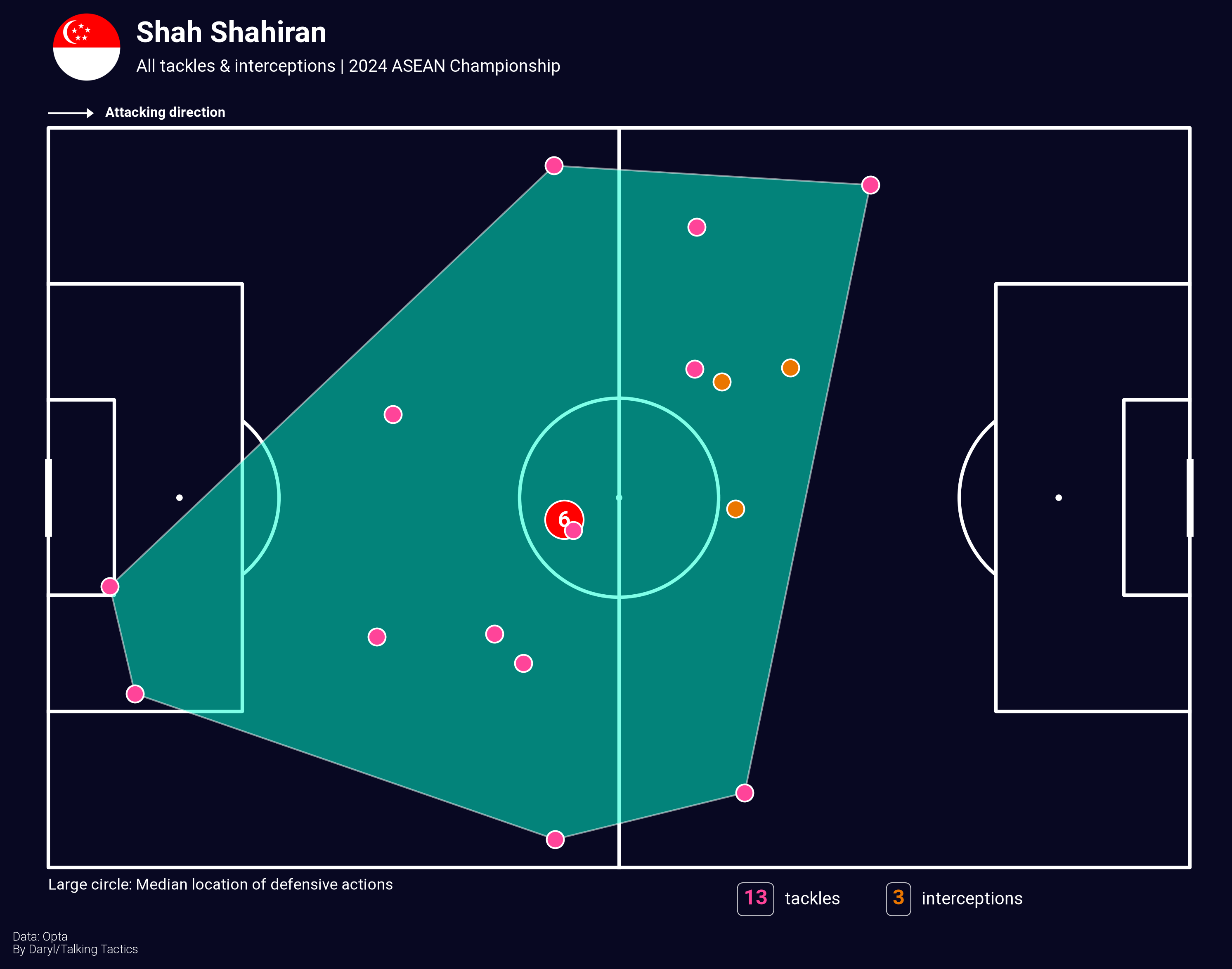
Because Shahiran was intended to be Singapore’s main defensive midfielder during the 2024 tournament, he also took on more defensive responsibilities to cover for Nakamura. Shahiran appeared almost everywhere inside his team’s own half to make tackles while also stepped into the opposition’s half to intercept passes. Throughout that tournament, Shahiran made 2.2 tackles and 0.5 interceptions per 90s, compared to Nakamura’s 1.4 tackles and 0 interceptions per 90s, a stark contrast in both of their defensive responsibilities under Ogura.
Throughout the 2024 ASEAN Championship, Singapore were a possession-heavy team as they controlled 55.2% of possession, only Thailand (58.5%) and Malaysia (57.5%) spent more time in possession than Singapore. As such, Nakamura’s contribution when the team had the ball was more beneficial to their playing style and could offset his lack of defensive contributions. His progressive passes helped the team with bringing the ball into the final third and reaching dangerous positions where they could score. But that was also Nakamura’s first major tournament with his new national team, a tournament where he was still somewhat overshadowed by Shahiran, who was already with the national team for a while.
There is also the caveat with small sample size whenever a team or player’s performance at the ASEAN Championship is examined. Most teams only play at least 4 matches during the group stage and at most 8 matches if they get to the final, which Singapore did not in 2024. It is hardly a good reflection of what long-term performance will look like, so it is worth taking all of these data in with a grain of salt.
But two years on from 2024 and Singapore have entered the latest edition of the ASEAN Championship with the same midfield pairing, with a new head coach in Gavin Lee, and without Sulaiman as one of their midfield options for the first time in a while. The former Tampines Rovers head coach opted to stick with the 4-2-3-1 formation that Ogura used in 2024, but they have diverted away from the possession-heavy playing style.
Throughout the 2026 group stage, Singapore only controlled 47% of ball possession, the 7th best out of the 10 teams that contested in the group stage. Even against Cambodia and Timor-Leste, teams that were considered weaker than Singapore, they only controlled 52% and 50% of the ball respectively. They did not create many goal-scoring chances either, registering just 16.25 touches in the penalty box (7th best), 4 shots on target (6th best), and 1.3 goals (7th best) from 1.275 xG per match (6th best).
This shift in playing style can be attributed towards Singapore’s preparation for the Asian Cup next year, where they will be playing against tougher oppositions like Australia and Iraq and will be on the back foot for the majority of the time. Their defensive numbers reflected this as well, they only conceded 2 goal from 3.6 xG conceded throughout the group stage while making the sixth-most interceptions (7.3) and fifth-most tackles (14.5) per match. The tests against stronger teams like Vietnam and Indonesia were beneficial for Gavin Lee and his coaching staff to measure the effectiveness of their approach and identify potential weaknesses in the run-up to next year’s Asian Cup.
Because of the playing style change, Shahiran and Nakamura’s roles have also been slightly tweaked compared to two years ago. Most notably, Shahiran has gone from a prolific passer deep inside Singapore’s half to a risk-averse passer who looked to recycle possession and made more backward and sideways passes. Instead, Nakamura was now seen as Singapore’s main playmaker thanks to his progressive and long passes, which were used to start counter-attacks from deep inside Singapore’s half. This played into the strengths of the Japanese-born midfielder as he was able to take more risks with his passes to find attackers positioned in between or attempted to run in behind the opposition’s defensive lines.


While still not at Shahiran’s level when it came to defending, but Nakamura also took on a bit more defensive responsibilities compared to 2024. Since Shahiran mostly operated on the right-hand side in Gavin Lee’s 4-2-3-1 formation, Nakamura had to be responsible for defending the left-hand side and supporting left-sided centre-back Jacob Mahler and left-back Nur Abdullah, especially when the team fell back into a 4-4-2 low-block.
But because Nakamura was not a natural defensive midfielder and his defending ability still had rooms to improve, many teams still attempted to attack Singapore’s left-hand side to various levels of success. Nakamura could be baited to leave his position to press an opposition player, which would leave the channel in between Mahler and Abdullah vulnerable to channel runs from an opposition midfielder or winger to drag Nakamura and/or Abdullah out of position, then created space for a full-back or a wing-back to make a cross into the box.


Defending was one of the main concerns when Nakamura became one of Singapore’s main options in midfield moving forward. While Shahiran could provide cover for his teammate when the team were defending, there was only so much that he could do while also having to defend his own area.
The solution that Gavin Lee went with during this tournament was to set up a narrow defensive block to have as much defensive support around Nakamura as possible. The trade-off was Singapore had to concede a lot of possession inside of their own half, but that solution worked to some extent in preventing dangerous attacks coming down the left half-space and made them one of the toughest defensive teams in this year’s ASEAN Championship. However, there is no guarantee that this solution will continue to work at the Asian Cup next year and against teams who just played at the World Cup like Australia or Iraq. It is hard to see Singapore switching to a 5-2-3 or a 5-4-1 anytime soon, but it is one of the solutions to keep in mind given how many good centre-backs options Gavin Lee has at his disposal like Hariss Harun, Safuwan Baharudin, Irfan Fandi, Lionel Tan, and now Jacob Mahler.
But defending is also not the reason why the Japanese-born midfielder is seen as a replacement for the legendary Shahdan Sulaiman, rather it is his playmaking ability, which he excels at. Nakamura’s passing ability has freed up Shahiran to do more of the dirty work to keep his team from conceding goals, while still retaining Singapore’s ability to generate counter-attacks thanks to their fast attacking players up front. His passes also encourage Singaporean attackers to run more in behind the opposition’s defence or attack the channels to enter the final third.
The challenge for Singapore now is converting the chances that Nakamura creates into actual, meaningful goals that can win games for the team. But it seems that Singapore have already found an answer to the question posed at the beginning, at least for the short-term run, and Singapore’s midfield will be in good hands heading into their first Asian Cup campaign since 1984 when they hosted the tournament.
How has Hêndrio Araújo (Đỗ Hoàng Hên)’s presence changed Vietnam’s attack?
Similar to Indonesia and to a slightly stronger extent to Singapore, Vietnam have also stepped up their effort to naturalise players for the national team. They have been searching for dual-nationals from across the world while also naturalising foreign players who have spent a considerable amount of time playing in the V-League.
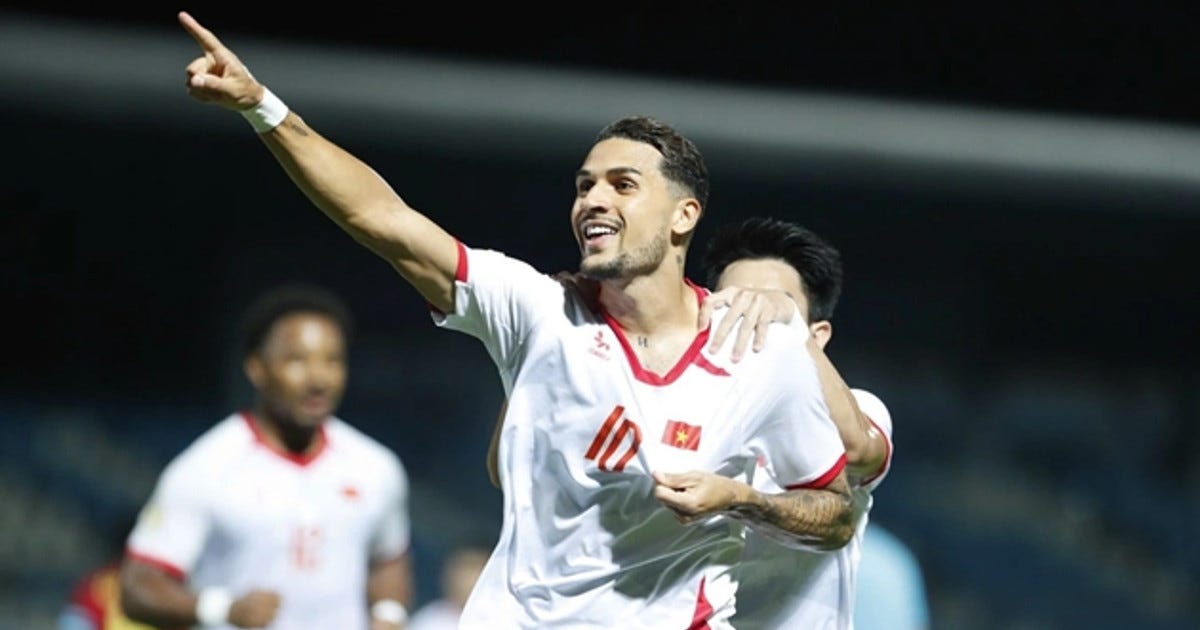
2024 saw the emergence of Rafaelson, or Nguyễn Xuân Son, as Vietnam’s main goalscorer as his performance before getting injured single-handedly carried the team to the final and, subsequently, won the entire tournament. This year, two more Brazilian-born players joined Rafaelson among Vietnam’s attacking options for the ASEAN Championship in Geovane Magno (Nguyễn Tài Lộc) and, most notably, Hêndrio Araújo (Đỗ Hoàng Hên).
Unlike Rafaelson and Magno, who are both natural strikers, Hêndrio is an attacking midfielder who can also play as a winger. In Kim Sang-sik’s 3-4-3 formation that he used during the 2026 ASEAN Championship, the Brazilian-born player was usually deployed as a right winger despite being mainly left-footed to make the most of his inside runs and attack the opposition’s left-sided channel.
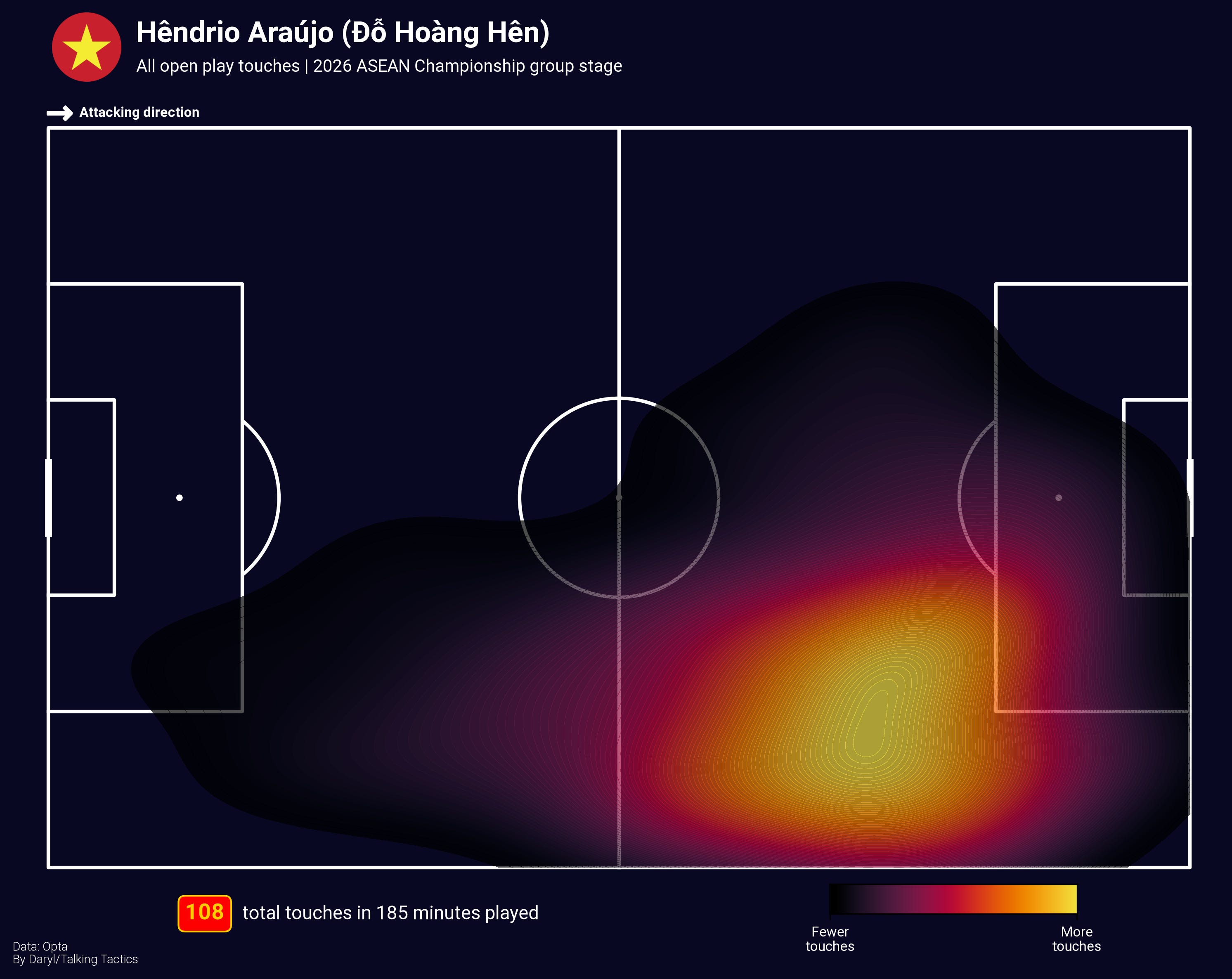
One player who has benefited from Hêndrio’s presence on the right was right wing-back Trương Tiến Anh. Thanks to Hêndrio’s run inside the half-space, the opposition defenders were pinned to the Brazilian-born player on the inside and left plenty of space on the outside for Tiến Anh to overlap into and make crosses. The accuracy from those crosses were…average at best, which was one of Vietnam’s main concerns after the group stage considering they relied somewhat heavily on both wings to get the ball into both the final third and the penalty box.
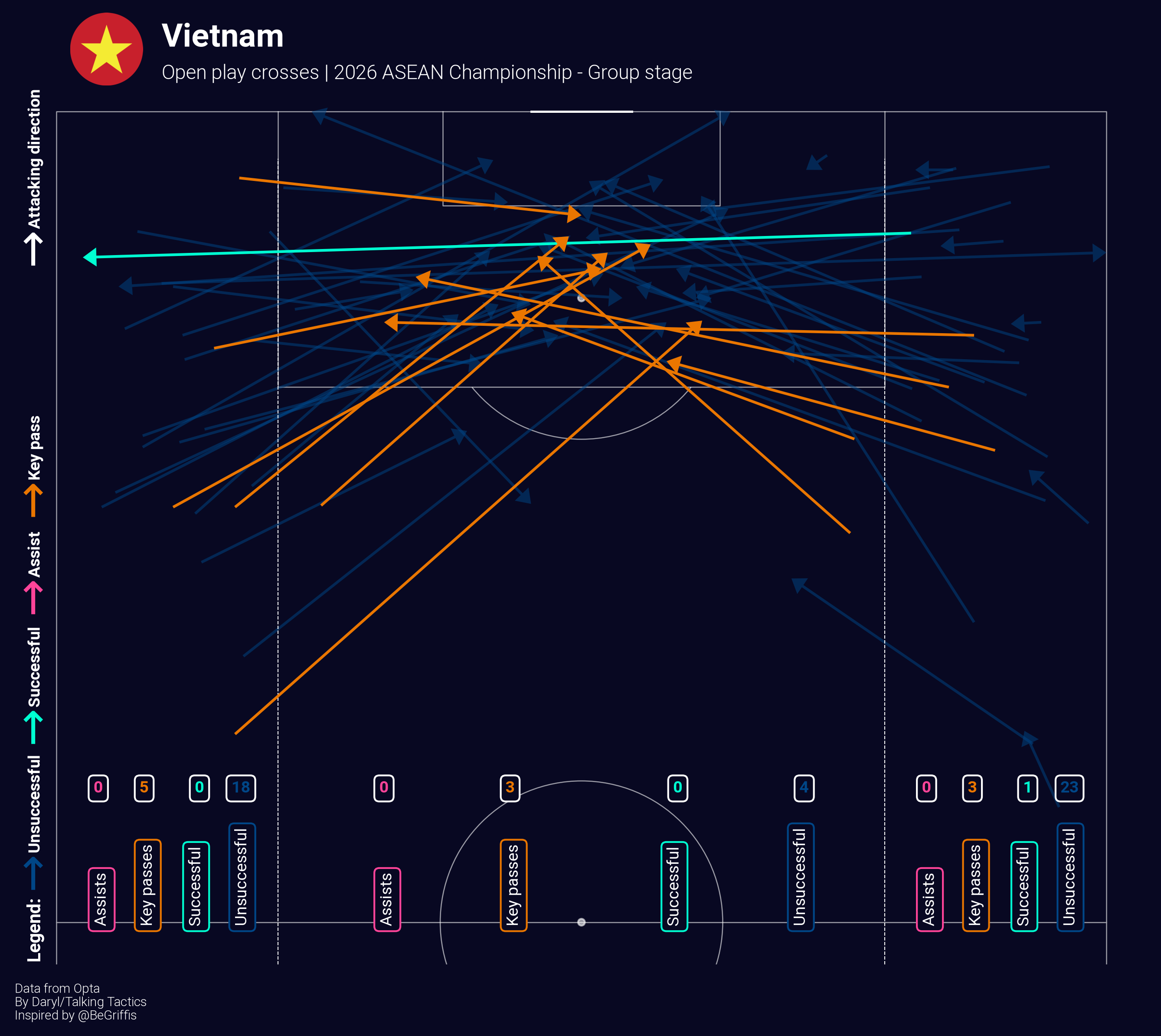
At least, compared to previous tournaments, having Hêndrio as an attacking midfield option has allowed both Nguyễn Quang Hải and Nguyễn Hoàng Đức to be used as the defensive midfield pairing and has opened up a different attacking option for Vietnam. Quang Hải and Hoàng Đức’s passing range and vision have allowed both players to make longer passes and through balls from deep to encourage players like Hêndrio, Rafaelson, and Nguyễn Đình Bắc to attack the closest channel to them or attack the space in behind the opposition’s defence. It was exactly that reason that allowed Hoàng Đức to finish the group stage with the joint-most assists (4) and the fourth-most chances created (11).
Against opponents who made it tough for Vietnam to attack like Singapore or Timor-Leste, both of whom opted to sit deep in a low-block, Hêndrio’s off-ball runs were crucial for his team since those runs pulled opposition defenders out of their position. That has allowed players like Tiến Anh or Quang Hải to receive the ball without being closed down and entered the penalty box more effectively.
Besides that, the Brazilian-born player also provided another goal-scoring outlet when Vietnam needed. His scoring record in the domestic league has been consistent and at a high level, which has taken a bit of pressure of the shoulders of the remaining attackers in the lineup. Hêndrio did not get into good goal-scoring positions throughout the group stage outside of the two goals that he scored against Timor-Leste, which explained why he finished the group stage with just 0.9 non-penalty xG. But, as mentioned, he was not Vietnam’s main goal-scoring outlet throughout the group stage and what he offered in possession was more than just scoring goals, which offsetted the lack of goals that Hêndrio scored during the group stage.
Hêndrio was also a key player in Vietnam’s defence, especially when the team pressed and defended in a mid-block. His work rate helped him maintained a consistent pressing level inside the opposition’s half to close down passing options, while his reading of the game allowed him to be in right positions to intercept passes and quickly regain possession for Vietnam.
Every naturalised player that have worn Vietnam’s shirt over the past few years have brought something different to the team and even proved to be a significant improvement, and Hêndrio was no different. After making his debut during the Asian Cup qualifying campaign against Malaysia, the Brazilian-born player was eased into the team at the ASEAN Championship, starting Vietnam’s first two matches and coming off the bench against Indonesia. It is still early days into Hêndrio’s time with the Vietnamese national team, but the glimpses of what he brought to the national team during the 2026 ASEAN Championship meant that Vietnam now have another dangerous attacking weapon moving forward.
Indonesia have endured a fairly disappointing elimination from the ASEAN Championship despite calling up many players with European experience for this tournament. Mitchell Baker has rightly taken the spotlight for Indonesia with his goal-scoring form during the first two matches of the group stage, but did Indonesia become too reliant on the young striker to score goals? Against teams with similar strengths like Vietnam and Singapore, it definitely seemed so as Timnas failed to score in both matches while both Baker and his backup option Jens Raven being used. John Herdman and his coaching staff will potentially have the return of Indonesia’s key players for the FIFA ASEAN Cup and the Asian Cup, but they will need to find other alternative options to not become reliant on Baker and Thom Haye for creating and scoring chances.
Meanwhile, Gavin Lee has continued to deliver as Singapore’s permanent head coach despite the change in playing approach, which is assumed to be their preparation for the Asian Cup next year. Shah Shahiran and Kyoga Nakamura have developed a very close relationship in Singapore’s midfield and their roles have been distinctly defined in Lee’s slightly new-look 4-2-3-1 system. They are not without their flaws, however, which Singapore and Gavin Lee will continue to work on as they look forward to the FIFA ASEAN Cup as another test and opportunity to tweak their approach and system before the biggest test in Singaporean football in a while starts in January next year.
Lastly, Vietnam have once again proved themselves to be one of the top teams in Southeast Asia with a complete performance during the group stage that saw them won all four matches, scored 13 goals, and conceded once. The inclusion of newly-naturalised players like Patrik Lê Giang (who I have looked at in the article below!), Geovane Magno, and Hêndrio have improved the quality of the team both in defence and in attack. The latter two Brazilian-born players were still being eased into the team, which meant that they were not able to showcase their full ability in higher-pressure situations. But given the promising glimpses of their performance during this ASEAN Championship campaign, they have made a good case for themselves to be considered for the final Asian Cup squad next year.

As for this review, I will be looking into Group B teams for the second and final article about this year’s ASEAN Championship! I don’t really want to cover the tournament in detailed like the 2024 edition ‘cause I don’t think it would be as interesting as trying to tell a story about each team using data like this article. Personally, I prefer writing articles like this one (and the previous two during the 2026 World Cup) because it allows me to explore deeper and more thorough about a single topic and look at topics from different perspectives using data and my own knowledge. So, expect more articles like this from me moving forward!